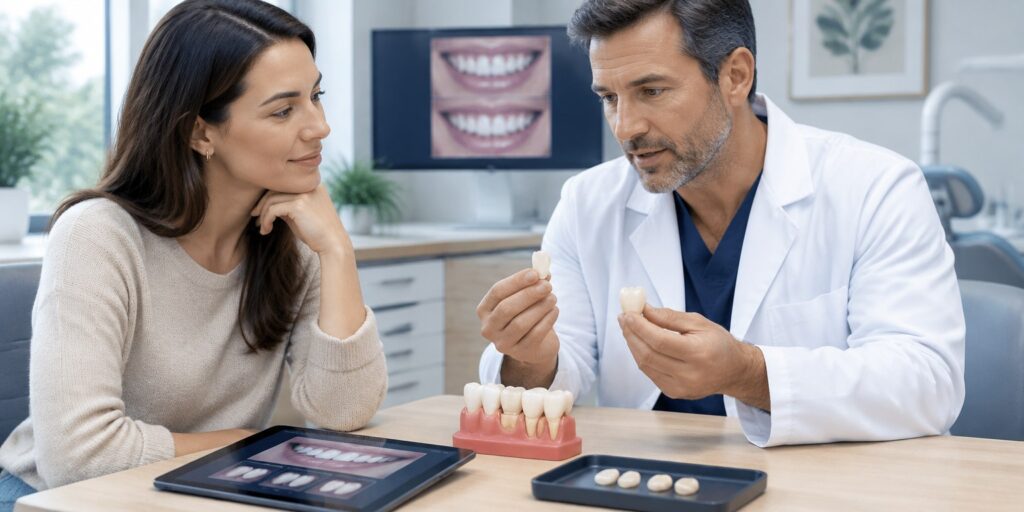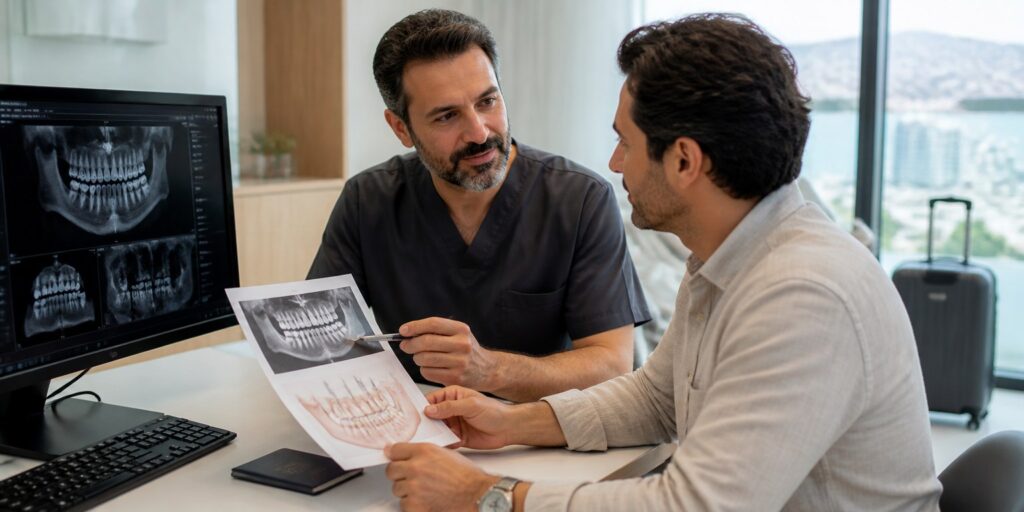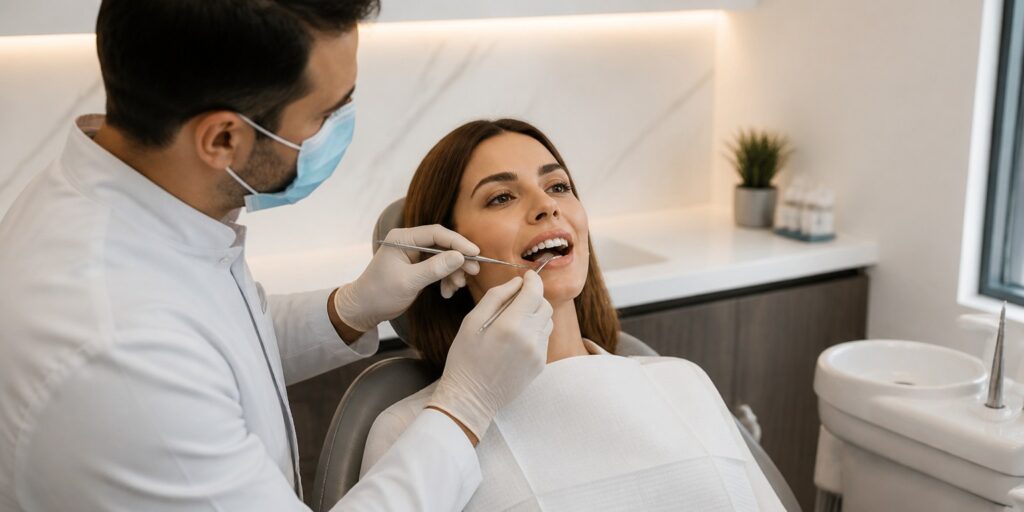


Emax veneers vs crowns differ mainly in tooth coverage and preparation. Compare purpose, enamel removal, durability, risks, and who may need each.

E-max veneers vs crowns differ mainly in how much of the tooth they cover and why the restoration is needed. A veneer usually covers the visible front surface of a tooth and is often chosen for selected cosmetic changes when enough healthy tooth structure remains. A crown covers substantially more of the tooth and is generally used when broader structural restoration or protection is required. Importantly, E-max is not the opposite of a crown: E-max / IPS e.max is lithium-disilicate ceramic material-system terminology, and lithium disilicate can be used to make both veneers and crowns in appropriate clinical situations.
Patients comparing the two should therefore ask two separate questions: Does this tooth need a veneer or a crown? And, after the restoration design is chosen, which ceramic material is appropriate?
Quick Answer: E-max Veneer vs Crown at a Glance
| Feature | E-max Veneer | Dental Crown |
|---|---|---|
| What it is | A thin partial-coverage restoration, commonly bonded mainly to the visible surface of the tooth | A restoration that covers substantially more of the prepared tooth |
| Main purpose | Selected aesthetic changes and minor restorative correction | Structural restoration, protection, and sometimes aesthetic correction |
| Tooth structure removed | Usually less when a veneer is genuinely indicated | Generally more because the crown surrounds more of the tooth |
| Typical starting tooth | Relatively healthy tooth with sufficient structure and favorable conditions for bonding | Weakened, fractured, heavily filled, substantially damaged, or otherwise structurally compromised tooth |
| Material | E-max refers to lithium-disilicate glass-ceramic material/system terminology | Crowns can be made from lithium disilicate, zirconia, metal-ceramic, and other materials |
| Reversibility | Irreversible if enamel/tooth structure is removed | Irreversible |
| Main decision | Is conservative partial coverage enough? | Does the tooth need broader protection and coverage? |
| Universal winner? | No | No |
For patients researching E-max veneer treatment at Niva Dental, the most important issue is not simply which restoration “looks better.” The treatment should match the condition of each tooth while preserving healthy structure where clinically appropriate.
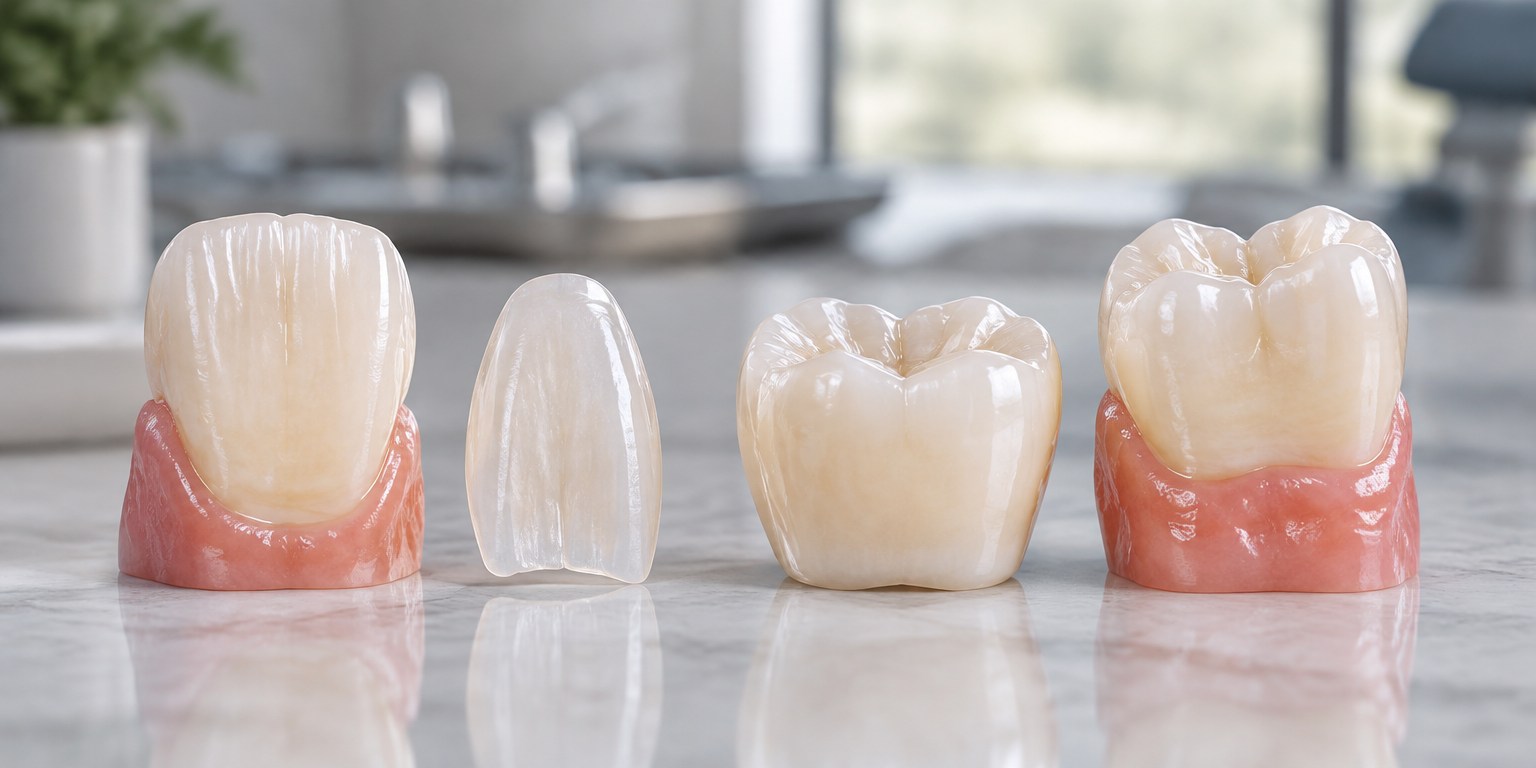
The First Difference to Understand: E-max Is a Material, Veneer and Crown Are Restoration Types
A veneer and a crown describe how a tooth is restored; E-max describes a ceramic material system. This distinction prevents one of the most common misunderstandings in cosmetic dentistry.
The American Dental Association describes a veneer as a custom-made covering that sits on the front surface of a tooth rather than covering the entire tooth structure. The ADA’s crown guidance explains that crowns are used to cover a tooth to restore its shape, size, strength, or appearance and may be recommended when significant tooth structure has been lost.
E-max / IPS e.max, meanwhile, is associated with lithium-disilicate glass-ceramic. Ivoclar’s technical information for IPS e.max CAD lists several possible restoration designs, including both veneers and single crowns.
This means all of the following can be true:
- an E-max veneer can be made from lithium disilicate;
- an E-max crown can also be made from lithium disilicate;
- a crown does not have to be E-max;
- a ceramic veneer does not automatically have to be E-max.
So the real comparison is often partial coverage versus full or extensive coverage, not “E-max versus crown.”
What Is an E-max Veneer?
An E-max veneer is a thin ceramic restoration used mainly on the visible surface of a selected tooth. When the term “E-max” is used precisely, it refers to lithium-disilicate-based ceramic material-system terminology rather than the definition of a veneer itself.
Veneers may be considered when a tooth is structurally suitable and the main concern involves:
- color that cannot be managed adequately with whitening;
- a small chip or worn edge;
- tooth shape or proportion;
- a small gap;
- selected mild positional irregularities;
- replacement of an existing veneer where appropriate.
The treatment is generally conservative compared with a full crown, but that does not mean it is always no-prep. Some cases require controlled enamel reduction to create space and correct contour. If enamel is removed, the change is irreversible.
A 2025 clinical study of ceramic veneers found that greater dentin exposure was associated with increased failure risk over follow-up periods of up to 15 years. The authors emphasized the importance of preserving enamel where possible. This does not mean every veneer must stay entirely in enamel, but it supports conservative treatment planning when the tooth allows it.
What Is a Dental Crown?
A dental crown covers substantially more tooth structure than a veneer and is generally chosen when the tooth needs broader structural restoration or protection.
The ADA notes that crowns may help strengthen a tooth with a large filling when insufficient natural tooth structure remains to hold the filling, protect a weak tooth from breaking, restore an already broken tooth, or address selected shape and discoloration problems.
A crown may be considered when a tooth has:
- extensive previous restorations;
- significant structural loss;
- a large fracture;
- severe wear;
- selected root-canal treatment needs or post-treatment structural concerns;
- a shape or color problem that cannot be predictably managed with a more conservative restoration;
- insufficient suitable structure for a veneer.
A crown is not automatically “better” because it covers more tooth. Greater coverage may be appropriate when a tooth genuinely needs it, but preparing a relatively healthy tooth for full coverage simply to achieve a cosmetic change carries a greater biological cost than a well-indicated veneer.
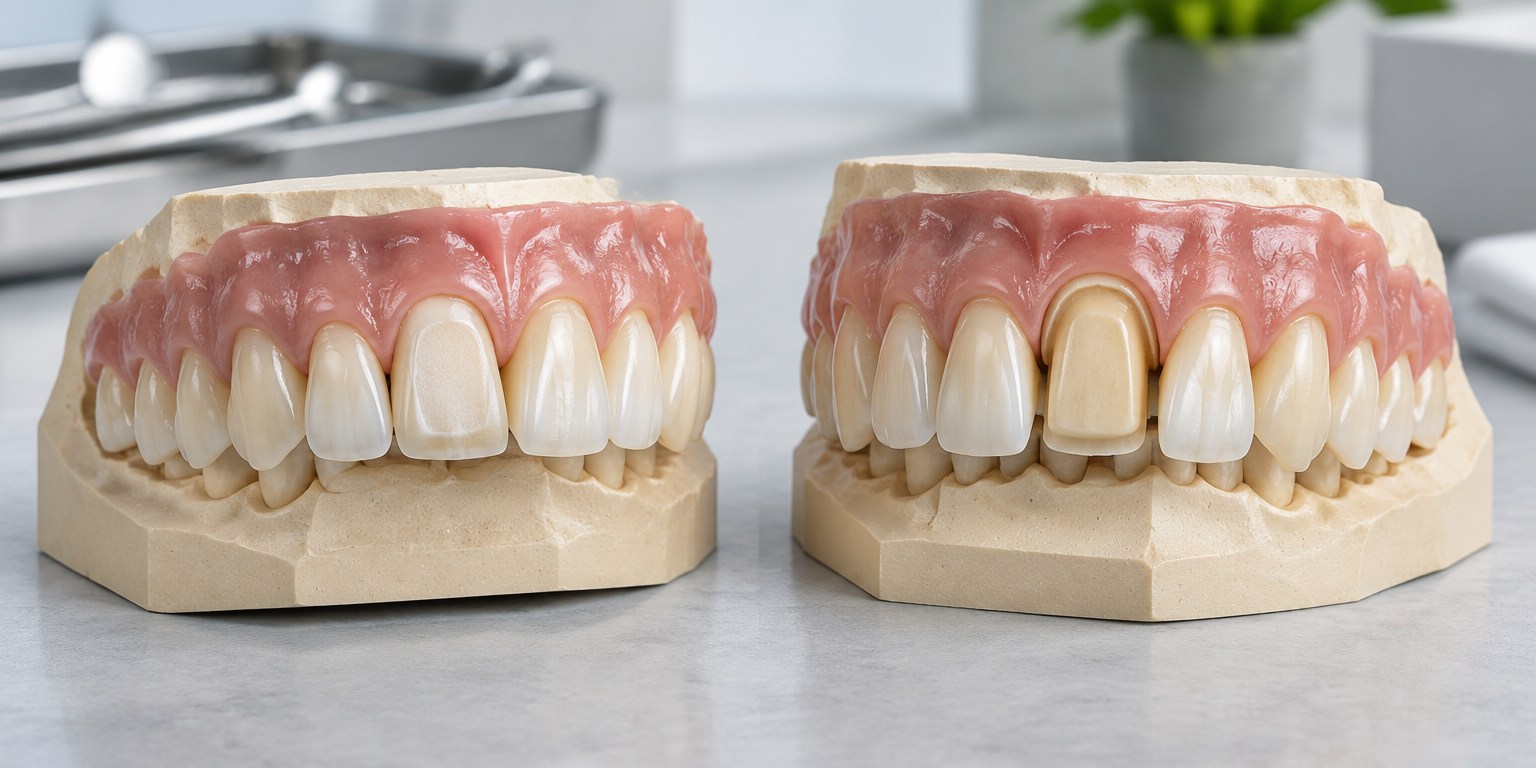
Emax Veneers vs Crowns: Detailed Comparison
| Decision Factor | E-max Veneer | Crown |
|---|---|---|
| Restoration design | Partial coverage, primarily facial/visible surface | Full or extensive coverage |
| Primary goal | Often aesthetic correction while preserving suitable natural tooth structure | Restore, strengthen, protect, and/or reshape a compromised tooth |
| Common material | Lithium-disilicate glass-ceramic when a true E-max material is used | Lithium disilicate, zirconia, metal-ceramic, and other restorative materials |
| Tooth preparation | Usually more conservative when appropriately indicated | Usually more extensive because more surfaces are covered |
| Enamel preservation | Often a major treatment goal | Less enamel may remain after preparation depending on the starting condition and crown design |
| Bonding/cementation | Adhesive bonding is central to many ceramic veneer protocols | Cementation or adhesive strategy depends on crown material, preparation, and clinical situation |
| Aesthetic potential | High when material, thickness, shade, texture, and underlying tooth are well managed | Can also be highly aesthetic; result depends on crown material and tooth/laboratory factors |
| Structural support | Limited by the underlying tooth and partial-coverage design | Broader coverage can protect teeth that need more structural reinforcement |
| Repair/replacement | May chip, fracture, debond, discolor at margins, or require replacement | May fracture, lose retention, develop marginal problems, or require replacement |
| Best suited to | Relatively healthy teeth needing selected cosmetic/limited restorative changes | Teeth needing more extensive restoration or protection |
| Reversible? | No if tooth structure is removed | No |
| Automatically preferable? | No | No |
The table is a framework, not a diagnosis. A tooth-by-tooth examination determines whether partial coverage is sufficient or whether full coverage is justified.
Which Requires More Tooth Preparation: Veneers or Crowns?
Crowns generally require more tooth preparation than veneers because a crown covers substantially more of the tooth. Veneers are usually more conservative when a tooth is healthy enough for partial coverage.
However, exact preparation varies.
A veneer may require more reduction when:
- the tooth projects forward;
- the tooth is rotated;
- significant discoloration must be masked;
- the existing contour is bulky;
- an old restoration must be removed;
- bite contacts require a different design.
A crown may already be the more logical option when the tooth has extensive structural damage or a large existing restoration. In that situation, the comparison is not simply “less shaving versus more shaving”; it is whether the tooth can be restored predictably with partial coverage at all.
Any removal of enamel or dentin is irreversible. For an elective cosmetic case, preserving healthy natural tooth structure should be part of informed decision-making.
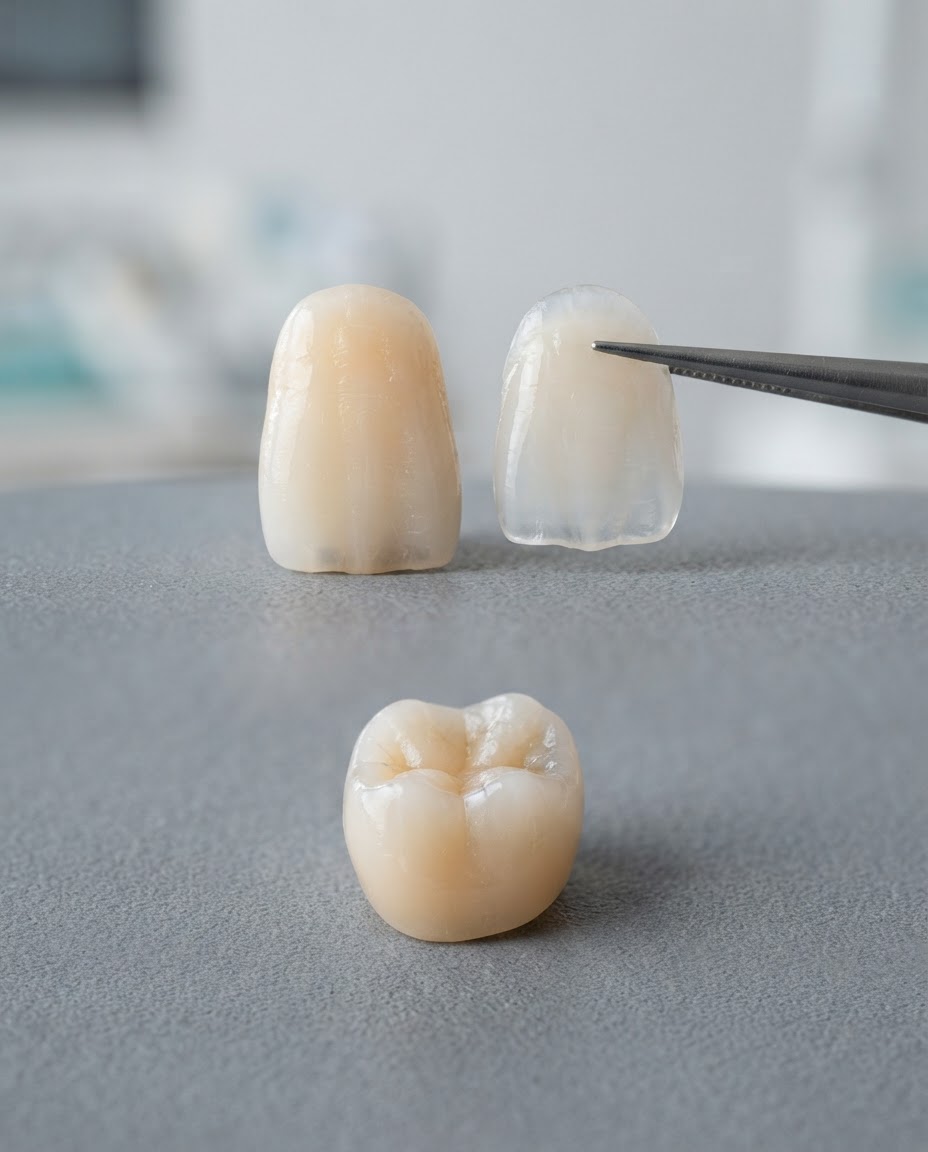
Which Looks More Natural: an E-max Veneer or a Crown?
Both can look natural when treatment is well planned; restoration design alone does not determine aesthetics. Lithium-disilicate ceramics are valued for optical properties that can support lifelike anterior restorations, but the final result also depends on the underlying tooth, ceramic thickness, translucency, opacity, shade selection, surface texture, margin placement, gum position, and laboratory work.
An E-max veneer may have an aesthetic advantage in a suitable front tooth because:
- less natural tooth structure may need to be removed;
- the restoration can remain relatively thin;
- the underlying enamel can contribute to the optical result;
- lithium disilicate offers controlled translucency options.
But a crown may provide better masking when a tooth is severely discolored, structurally altered, or already heavily restored. In some cases, a more opaque ceramic or different crown material may be needed.
That is why “veneers always look more natural than crowns” is too simplistic.
The better question is: Which restoration and material can achieve the required optical result without unnecessary removal of healthy tooth structure?
Are Crowns Stronger Than E-max Veneers?
A full crown provides more extensive structural coverage than a veneer, but “stronger” is not the same as “better.” The amount of remaining natural tooth, ceramic material, restoration thickness, bite forces, cementation, tooth position, grinding habits, and design all influence clinical performance.
Current evidence supports good performance for both ceramic veneers and lithium-disilicate crowns when used appropriately.
A systematic review and meta-analysis of ceramic laminate veneers reported a pooled survival rate of 96.81% for lithium-disilicate veneers at a mean follow-up of approximately 10.4 years. A separate 2026 systematic review and meta-analysis of tooth-supported single crowns reported a pooled five-year survival rate of 98.5% for monolithic lithium-disilicate crowns.
These percentages should not be directly compared as though crowns “beat” veneers. They come from different evidence sets, restoration designs, follow-up periods, tooth conditions, and patient populations. Survival also does not mean a restoration remained completely free of complications.
The practical point is simpler: both restoration types can perform well when the indication, preparation, material, bonding/cementation, occlusion, and maintenance are appropriate.
When Might an E-max Veneer Be More Appropriate?
An E-max veneer may be the more conservative option when a tooth is largely healthy and the main treatment goal is aesthetic.
Examples may include a suitable tooth with:
- a stable but undesirable color;
- small shape or proportion concerns;
- a localized chip or worn edge;
- a small gap;
- selected mild positional discrepancies;
- enough suitable enamel for predictable adhesive treatment;
- a favorable bite for the planned restoration.
Before treatment, the dentist should also check for decay, gum disease, bruxism, cracks, old restorations, and bite relationships.
If the cosmetic problem can be solved with whitening, orthodontics, or additive composite bonding, those alternatives may preserve even more natural structure.
When Might a Crown Be More Appropriate?
A crown may be more appropriate when a tooth has lost enough structure that partial coverage would not provide adequate protection or restoration.
Examples can include:
- a very large existing filling;
- major fracture or structural weakness;
- extensive decay after disease control and restorative planning;
- severe wear;
- selected root-canal-treated teeth requiring broader protection;
- substantial pre-existing preparation;
- severe discoloration combined with structural compromise.
The indication should come from the condition of the tooth, not from a cosmetic package.
A healthy front tooth that only needs a modest aesthetic change does not automatically need a crown simply because crowns can be made strong or opaque.
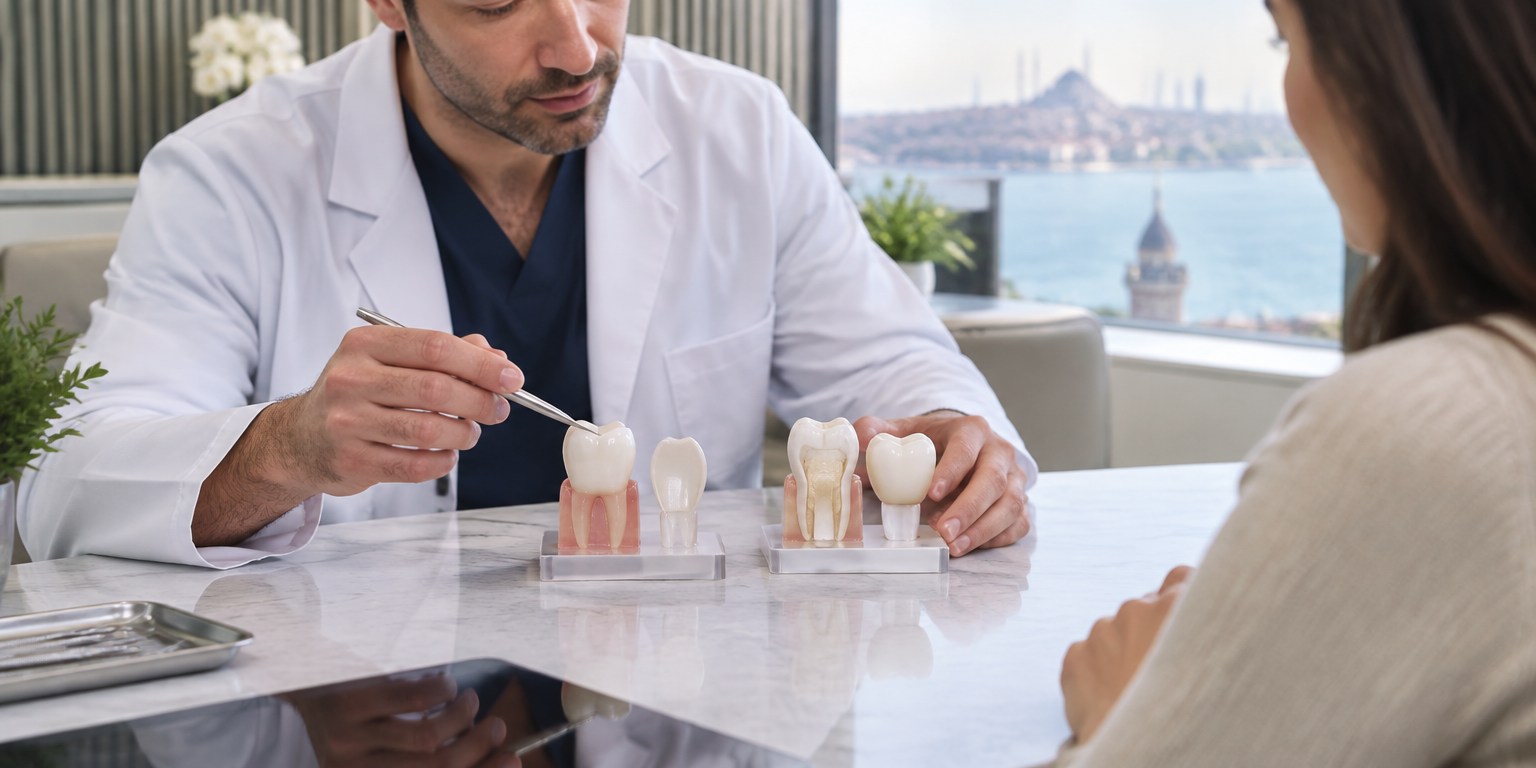
What Are the Risks and Limitations of Veneers and Crowns?
Both treatments are irreversible when natural tooth structure is prepared, and both can require maintenance or replacement later.
Possible veneer-related issues
- sensitivity;
- chipping or fracture;
- debonding;
- marginal staining;
- gum irritation;
- secondary decay around margins;
- bite-related complications;
- eventual repair or replacement.
Possible crown-related issues
- sensitivity;
- pulpal irritation or later endodontic complications;
- fracture or chipping;
- loss of retention;
- gum or margin problems;
- secondary decay;
- wear of the opposing tooth depending on material and surface condition;
- eventual replacement.
A crown may be more invasive, but a veneer that is placed on the wrong tooth can also fail. Conservative treatment means using the least invasive restoration that can reliably solve the actual clinical problem, not always choosing the thinnest restoration.
What Alternatives Should Be Considered Before Veneers or Crowns?
Some cosmetic concerns can be managed without either a veneer or a crown.
Depending on the diagnosis, alternatives may include:
- professional teeth whitening when color is the primary concern;
- composite bonding for selected chips, gaps, or small shape changes;
- orthodontics or clear aligners when tooth position is the main issue;
- partial-coverage restorations in selected damaged posterior teeth;
- observation / no cosmetic treatment when intervention is not necessary.
The ADA notes that whitening changes natural tooth color but does not whiten existing veneers, crowns, or fillings. This is another reason treatment sequencing matters: if whitening is planned, it may need to be completed before selecting the final shade of new ceramic restorations.
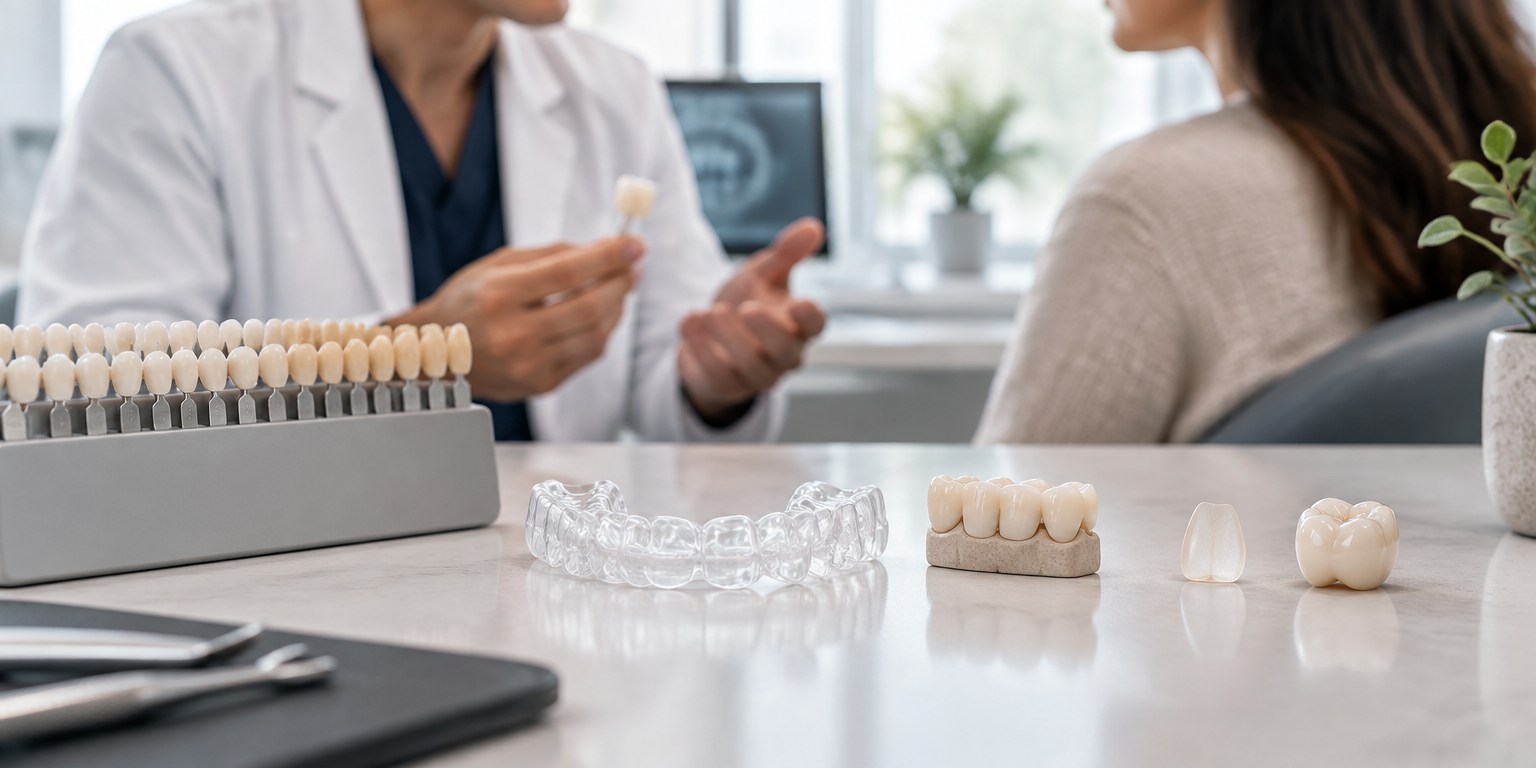
What Should International Patients Ask Before Choosing Veneers or Crowns in Turkey?
Patients traveling for cosmetic dentistry should confirm exactly which teeth are receiving veneers and which are receiving crowns before irreversible treatment begins.
Useful questions include:
- Is each proposed restoration a veneer or a crown?
- Why does this specific tooth need that amount of coverage?
- How much healthy tooth structure is expected to be removed?
- Can a more conservative treatment achieve the same goal?
- Is “E-max” describing the actual ceramic material, or is it being used loosely as a marketing term?
- If a crown is proposed, which crown material is recommended and why?
- How will decay, gum health, cracks, previous restorations, and the bite be assessed?
- How will clenching or grinding affect the treatment plan?
- What happens if the in-person examination changes the preliminary plan?
- What long-term maintenance or replacement should be expected?
Patients planning treatment with Niva Dental in Bakırköy, Istanbul can review the Niva Dental patient journey for the broader consultation and international-patient process.
When multiple teeth are being considered as part of a broader aesthetic plan, the conversation may extend beyond individual veneers or crowns into Hollywood Smile treatment planning. The restoration chosen for each tooth should still be based on its individual condition.
Emax Veneers vs Crowns: Which May Fit Which Situation?
For emax veneers vs crowns, the most useful decision rule is:
- Relatively healthy tooth + mainly cosmetic change + suitable enamel and bite: a veneer may be the more conservative option.
- Substantially weakened, fractured, heavily restored, or structurally compromised tooth: a crown may be more appropriate.
- Color problem only: whitening may deserve consideration before either ceramic restoration.
- Position problem only: orthodontics may preserve more natural tooth structure.
- Different teeth with different needs: a mixed plan can be appropriate.
There is no responsible universal winner.
The restoration should be chosen tooth by tooth, with healthy tissue preservation, function, aesthetics, long-term maintenance, and patient preferences considered together.
Frequently Asked Questions
Is an E-max veneer the same as an E-max crown?
No. E-max refers to lithium-disilicate ceramic material-system terminology, while veneer and crown describe different restoration designs. An E-max veneer primarily covers the visible surface of a suitable tooth. An E-max crown covers substantially more of the prepared tooth. The same broad ceramic system can therefore be used for more than one restoration type.
Which is better, an E-max veneer or a crown?
Neither is universally better. A veneer may be preferable when a tooth is mostly healthy and only needs selected cosmetic or minor restorative correction. A crown may be preferable when the tooth needs broader structural protection. The right choice depends on remaining tooth structure, decay, cracks, previous restorations, bite forces, and treatment goals.
Do crowns require more tooth shaving than veneers?
Generally, yes. Crowns cover substantially more of the tooth, so they usually require more extensive preparation. Veneers are often more conservative, but the amount of enamel reduction varies with tooth position, color, shape, previous restorations, and the planned final contour. Any removed tooth structure is irreversible.
Can a crown also be made from E-max?
Yes. IPS e.max CAD and Press are lithium-disilicate glass-ceramics used for multiple restoration types, and crowns are among the indications described by the manufacturer. This is why “E-max versus crown” is not technically a material-versus-material comparison. A dentist first chooses the restoration design and then selects an appropriate material.
Are E-max veneers suitable for damaged teeth?
It depends on how much healthy tooth structure remains and what kind of damage is present. A small chip or selected surface defect may be compatible with a veneer, while a heavily filled, fractured, severely worn, or structurally weak tooth may require broader coverage. A clinical examination is needed to determine whether a veneer provides enough protection.
Which lasts longer, veneers or crowns?
There is no universal lifespan comparison that applies to every patient. Both ceramic veneers and crowns can show high survival in appropriately selected cases, but they are used on different teeth for different reasons. Bite forces, remaining tooth structure, material, bonding/cementation, hygiene, decay risk, bruxism, and maintenance all influence longevity.
Can I have veneers on some teeth and crowns on others?
Yes. A mixed restorative plan can be clinically appropriate because different teeth may have different needs. One relatively healthy front tooth may be suitable for a veneer while another heavily restored or structurally compromised tooth may need a crown. The key is to avoid applying the same restoration design to every tooth simply for uniformity.
Are crowns better for very dark teeth?
A crown can provide more room for masking materials when a tooth is severely discolored, but color alone does not automatically justify full-coverage preparation. The dentist should assess the cause of discoloration, remaining tooth structure, ceramic opacity, thickness, and alternatives such as whitening or a carefully designed veneer.
Should healthy teeth be crowned for cosmetic reasons?
A crown can improve appearance, but preparing a healthy tooth for full coverage removes more natural structure than a veneer or additive alternative. If the goal is purely cosmetic, patients should ask whether whitening, bonding, orthodontics, or a conservative veneer could meet the same objective. The least invasive predictable option should be considered.
Appropriate CTA
Patients deciding between E-max veneers and crowns can contact Niva Dental in Bakırköy, Istanbul for an initial evaluation. The final choice should follow an individual dental examination that considers remaining tooth structure, decay, previous restorations, bite, gum health, aesthetic goals, and whether a more conservative alternative could meet the same need.
Medical References and Sources
| Source | What It Supports |
|---|---|
| American Dental Association / MouthHealthy — Veneers | Veneers cover the front surface rather than the entire tooth; veneer treatment is irreversible when enamel is removed; common indications and patient considerations. |
| American Dental Association / MouthHealthy — Crowns | Crowns cover teeth to restore shape, size, strength, or appearance and may be used for weak, broken, or heavily restored teeth. |
| American Dental Association — Materials for Indirect Restorations | Ceramic restorative material categories, lithium-disilicate performance, and evidence relevant to indirect restorations. |
| Klein P, et al. — Survival and Complication Rates of Ceramic Laminate Veneers — PMID 39523553 | Systematic review/meta-analysis reporting long-term survival data for lithium-disilicate laminate veneers. |
| Pjetursson BE, et al. — Systematic Review and Meta-analysis of Tooth-Supported Single Crowns — PMID 41489982 | 2026 evidence on five-year survival and complications of metal-ceramic and all-ceramic single crowns, including monolithic lithium disilicate. |
| Ivoclar — IPS e.max CAD | Technical confirmation that IPS e.max CAD is lithium-disilicate glass-ceramic and can be used for restorations including veneers and crowns. |