

Dental implant failure symptoms can include pain, swelling or looseness. Learn what needs dental review, when to seek urgent help and how problems are assessed.

Dental implant failure symptoms can include persistent or worsening pain, swelling, bleeding, discharge or a loose-feeling implant restoration. These are reasons to seek assessment, not proof that the implant must be removed. A loose connecting screw can feel like a loose implant, while inflammation may develop without obvious symptoms.[1,2]
Contact a dentist promptly if something changes around your implant. If swelling makes breathing, swallowing or speaking difficult, seek emergency medical help immediately. Significant mouth swelling or swelling around the eye with visual changes also requires emergency assessment.[3]
The first step is to establish what is affected: the implant in the bone, the surrounding tissues or the replacement tooth attached to it.
What are the warning signs of a dental implant problem?
New or worsening symptoms deserve attention even if the implant has worked comfortably for years. Use the following signs to describe your concern to a dentist; they cannot identify the cause on their own.
| What you notice | What to do |
|---|---|
| An implant crown or bridge feels loose, shifts or clicks | Contact your dentist promptly and describe the movement; do not repeatedly test it |
| Pain persists, worsens or returns after settling | Ask for a dental assessment, particularly if biting is painful |
| Gums repeatedly bleed or become swollen around the implant | Arrange a review rather than assuming this is normal |
| Pus, a persistent bad taste or fever | Seek urgent dental advice, preferably the same day |
| New or continuing numbness or tingling after the local anaesthetic should have worn off | Contact the treating clinician promptly |
Bleeding, swelling and an unpleasant taste can accompany peri-implant disease.[2] Fever and pus warrant assessment, and altered sensation can reflect a surgical nerve complication rather than implant failure itself.[8,10]
Tell the clinic when the implant was placed, when the symptoms began and whether they are worsening. Mention whether you have a temporary restoration or the final crown or bridge.
What can be normal during healing, and what is concerning?
Some soreness, swelling, bruising and minor bleeding can occur after implant surgery. Guy’s and St Thomas’ NHS Foundation Trust notes that discomfort commonly lasts up to a week, although experiences vary.[4] Leeds Teaching Hospitals explains that swelling and bruising are often worse during the first 24–48 hours.[5]
The overall pattern matters. Symptoms should follow the recovery course explained by your surgeon. Increasing pain, spreading swelling, fever or discharge should not be dismissed because surgery was recent. Ask the treating team if recovery differs from their instructions.[4,10]
A calendar cannot confirm that healing is normal. The extent of surgery and any additional procedures affect recovery. Equally, pain around an implant months or years later should not be explained away as ordinary postoperative healing.
Seek emergency help for severe swelling affecting breathing or swallowing, or significant mouth or eye-area swelling. Bleeding that does not stop despite the pressure measures in your postoperative instructions also needs urgent emergency assessment.[3,4]

Early failure, late failure and loose components are different
Early failure: the implant does not integrate with bone
Osseointegration is the process through which bone forms a stable attachment to an implant. Early failure occurs when that attachment does not develop successfully. A dentist needs to assess the implant and discuss the next treatment options.[5]
Late failure: an established implant loses support
An implant can develop problems after successful healing. Peri-implant mucositis is inflammation of the surrounding soft tissues. Peri-implantitis involves inflammation and loss of supporting bone, which can eventually threaten implant stability.[2]
These conditions require different assessments and treatment. Gum inflammation alone should not be labelled as a failed implant.
Mechanical problems: the replacement tooth or connection
The abutment is the connector between the implant and its restoration. A loose abutment screw can produce movement even when the implant body remains in the bone.[1]
This distinction explains why a loose-feeling tooth needs examination before anyone promises a simple repair or recommends removal. Avoid trying to tighten, glue or reposition a component yourself.
What can contribute to implant failure?
Failure can involve several factors, and symptoms alone cannot establish responsibility or the cause.
Smoking and poorly controlled diabetes can affect healing or increase failure risk.[1] A history of gum disease and inadequate plaque control are associated with peri-implant problems.[2] Local bone conditions, some medical treatments and certain medicines also need consideration in the clinical assessment.[5]
Grinding or clenching, known as bruxism, can matter. A systematic review found greater implant failure risk among patients classified as probable bruxers.[9] This is an association; it does not establish that grinding caused a particular person’s problem.
Bring a current medication list and explain changes in your health, smoking habits, bite or cleaning routine. Do not stop prescribed medication without speaking to the clinician responsible for it.
What should you do while arranging an assessment?
Contact the treating clinic and explain the symptoms clearly. If they cannot assess you promptly, arrange appropriate local dental care. Urgent symptoms should not wait for a remote reply or an international flight.
While waiting:
- Leave moving parts alone. Avoid deliberately rocking the restoration or chewing hard foods on the affected area.
- Follow your existing postoperative instructions. Cleaning advice for a recent surgical wound may differ from routine care of a healed implant.[4]
- Use medicines only as directed. Do not start leftover antibiotics or rely on a mouthwash to resolve an undiagnosed problem.
- Prepare useful records. Gather the treatment date, implant details, recent correspondence and any available dental images.
A photo may help explain your concern, but it cannot establish implant stability or the condition of the supporting bone. When contacting a clinic, ask for a clear answer about where and how soon you should be examined.
How does a dentist assess a possible implant failure?
Assessment combines an examination with appropriate imaging and your treatment history. For suspected peri-implant disease, the dentist checks inflammation, bleeding or discharge during gentle probing, changes in the depth of the spaces around the implant and supporting bone levels. Earlier measurements and radiographs help identify changes.[6]
Ask the clinician to explain the findings in plain language:
- Is the concern mainly the crown or connection, the surrounding tissues, or the implant itself?
- Is there evidence of progressive bone loss?
- What treatment is proposed, and what alternatives are reasonable?
- What follow-up will show whether treatment is working?
Request a written summary, especially if more than one clinic will be involved in your care.
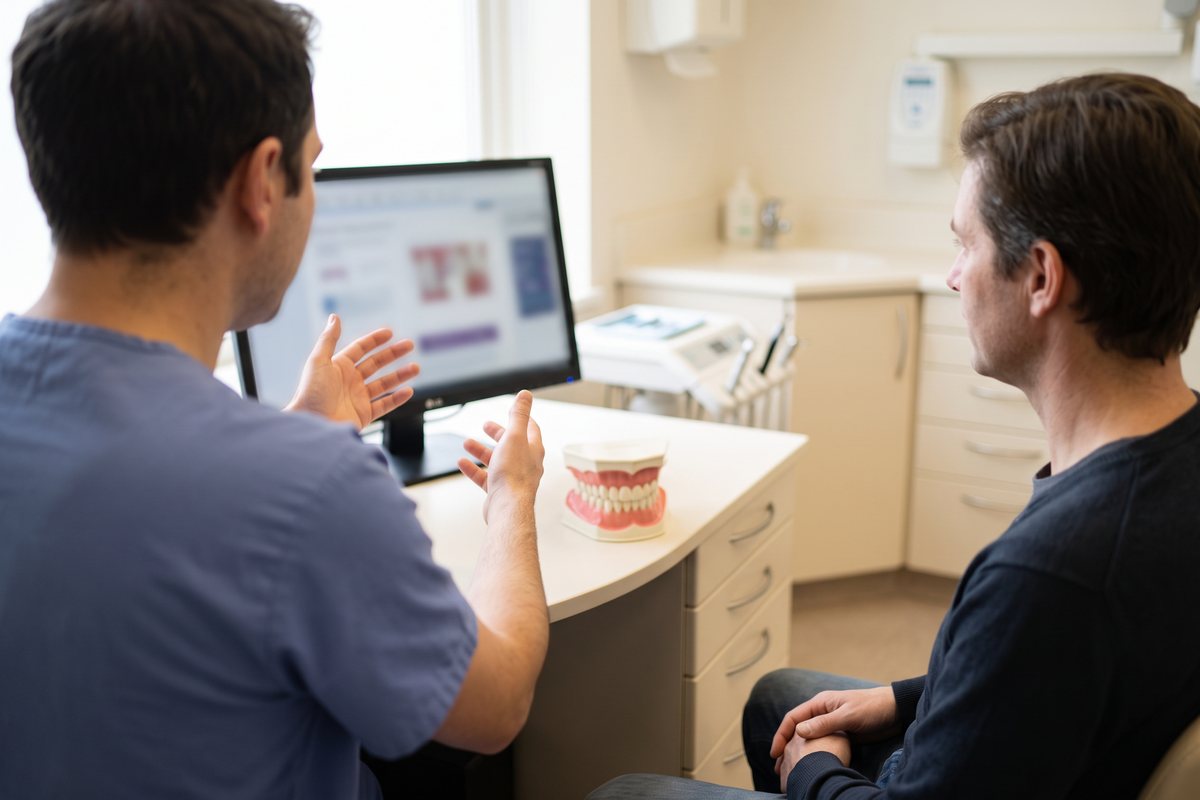
Can a dental implant problem be treated without removal?
Some problems can be managed while retaining the implant, but the answer depends on the diagnosis. Peri-implant mucositis is treated through improved plaque control and professional cleaning. Peri-implantitis may require non-surgical treatment, reassessment and, in some cases, surgery.[7]
If an implant has failed to bond to bone, removal may be necessary. Replacement can sometimes be considered after healing, depending on why it failed and the condition of the site.[8] A new implant is not an automatic next step; alternatives should be discussed.
Antibiotics are not a universal solution. The European Federation of Periodontology guideline advises against routine systemic antibiotics as an adjunct to non-surgical peri-implantitis treatment. A clinician must decide whether they are appropriate for the particular presentation.[6]
Ask what the proposed treatment aims to achieve, what uncertainty remains and what would trigger a change of plan.
Frequently asked questions
Can an implant fail without pain?
Yes. Peri-implant disease can be difficult to recognise yourself. Lack of pain does not confirm healthy tissues, so keep scheduled reviews.[2]
Does a loose implant crown mean the implant has failed?
Not necessarily. A loose connecting screw can produce similar movement, so an examination is needed.[1]
Can an implant fail years after placement?
Yes. Late failure can occur after initial healing, including through progressive loss of supporting bone.[5]
Can I treat an implant infection at home?
Home cleaning supports treatment, but suspected infection needs professional assessment. Mouthwash or antibiotics alone should not replace diagnosis and appropriate dental treatment.[6,7]
What if my implant was placed in another country?
Seek local assessment when needed and share the findings with the treating clinic. Bring available records and ask both teams how ongoing care will be coordinated. Emergency symptoms require immediate local help.[3]
Discuss your concerns with a dental professional
For treatment background, visit Niva Dental’s dental implant information page. If you received care at Niva Dental in Bakırköy, Istanbul, contact the treating team with your symptoms and treatment date. Follow the urgency guidance above rather than waiting for a routine consultation.
This article provides general information and cannot diagnose implant failure. Symptoms require individual assessment by a dentist; emergency warning signs require immediate medical attention.
Sources
- US Food and Drug Administration. Dental Implants: What You Should Know.
- European Federation of Periodontology. Peri-implant diseases.
- NHS. Dental abscess — urgent and emergency warning signs.
- Guy’s and St Thomas’ NHS Foundation Trust. Dental implants: After having a dental implant.
- Leeds Teaching Hospitals NHS Trust. Dental Implants — patient information.
- Herrera D, et al. Journal of Clinical Periodontology, 2023. Prevention and treatment of peri-implant diseases: The EFP S3 level clinical practice guideline.
- European Federation of Periodontology. Peri-implant disease: Treatment.
- Cambridge University Hospitals NHS Foundation Trust. Insertion of dental implants and Dental implants in restorative dentistry.
- Häggman-Henrikson B, et al. Journal of Oral Rehabilitation, 2024. Bruxism and dental implants: A systematic review and meta-analysis.
- Cleveland Clinic. Dental Implants — when to contact your dentist.