

A smile makeover combines treatments such as whitening, bonding, veneers and orthodontics. Compare options, timing and cost factors before you ask for a plan.


A smile makeover is a personalised treatment plan that combines two or more cosmetic dental treatments, such as whitening, bonding, veneers, crowns, orthodontics or gum contouring, to change how the teeth and gums look. It is not one procedure, so the steps, the time needed and the cost differ from person to person. [1]
This guide sets out the treatments a plan can include and what each one changes, how the planning works, how long the stages take, what drives the price, and what to check if you intend to have the work done abroad.
Key takeaways
- The treatment is a plan, not a single procedure: two people can receive completely different combinations.
- Cosmetic dentistry focuses on appearance; a full mouth reconstruction rebuilds or replaces all the teeth to restore health and chewing as well. [1][2]
- Whitening and bonding usually remove no enamel, while veneers and crowns do, and most veneers cannot be reversed. [3][4]
- Cavities and gum disease need treating before cosmetic work starts. [3]
- Timing ranges from a single visit for bonding to 1 to 2 years for fixed braces. [4][6]
- Ask for the plan in writing, tooth by tooth, before you agree to anything or book travel.
What is a smile makeover?
The term describes a combination of cosmetic dental treatments chosen for one person and carried out in a planned order. “Cosmetic dentistry” is the branch of dentistry that focuses on improving the appearance of the smile, including the balance and symmetry of teeth and gums. [1]
The phrase is a marketing term, not a clinical diagnosis. One plan may be whitening plus bonding on two chipped teeth; another may involve orthodontics, gum contouring and eight veneers. In Turkey the same idea is usually sold as a “Hollywood Smile”, and Niva’s page on Hollywood Smile treatment in Turkey describes that version.
What a plan should never be is a fixed package chosen before anyone has examined your mouth. Serious problems such as extensive cavities or gum disease need treating before cosmetic work. [3]
What are the smile makeover options, and what does each one change?
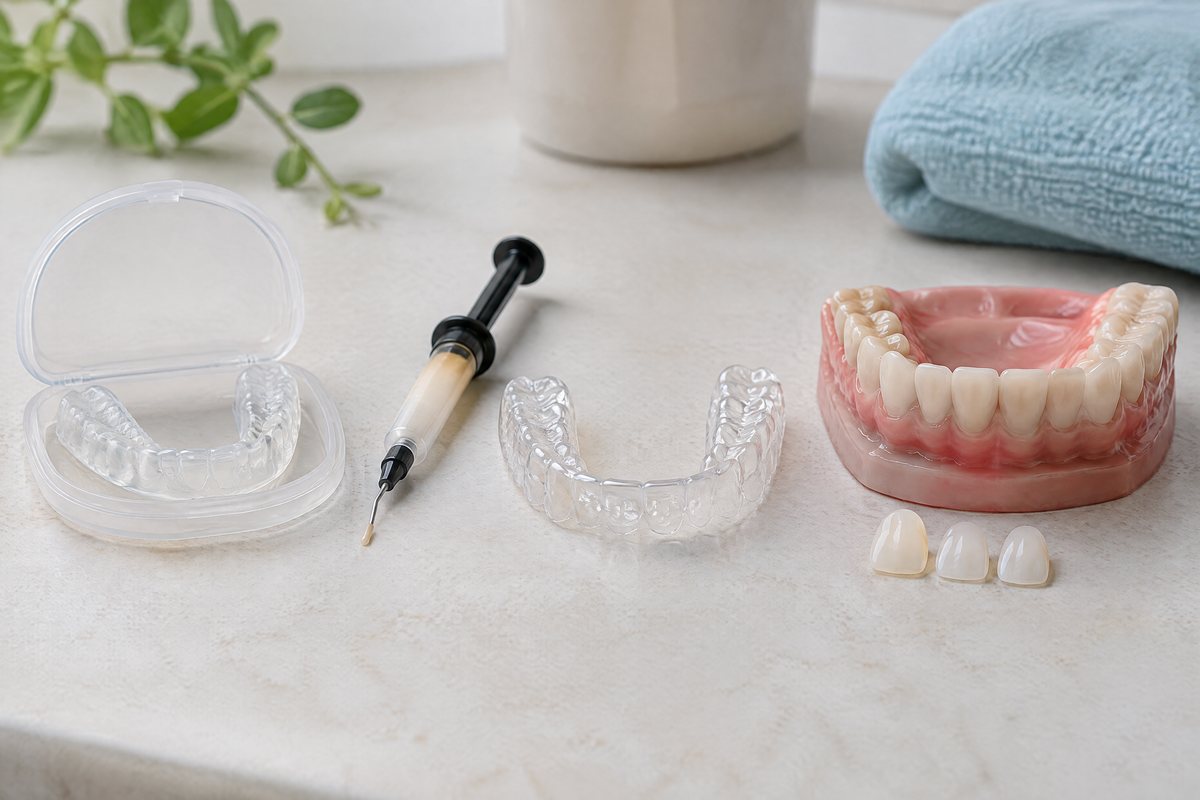
The main options are whitening, bonding, veneers, crowns, orthodontics, tooth and gum contouring, and replacement of missing teeth. Each changes something different, and they differ sharply in how much natural tooth they remove.
| Treatment | What it changes | Effect on the natural tooth | Typical time | How long results are reported to last |
|---|---|---|---|---|
| Professional whitening | Shade of natural teeth; does not change fillings, crowns or veneers [5] | No tooth removed; temporary sensitivity possible [5] | About an hour in the clinic, or 1 to 2 weeks with custom trays [5] | 6 months to 3 years [1] |
| Dental bonding (composite) | Shape, small chips, gaps, discolouration [4] | Usually no enamel removed; reversible [4] | 30 to 60 minutes per tooth, usually one visit [4] | 3 to 10 years [4] |
| Veneers | Front surface: chips, gaps, stubborn stains, small or misshapen teeth [3] | Some enamel removed; most types are permanent [3] | Usually two visits, with laboratory work between [3] | 10 to 15 years [3] |
| Crowns | Whole tooth is covered; adds strength to badly damaged teeth [3] | A significant amount of enamel removed [4] | Ask for the schedule in writing | Depends on tooth and material |
| Orthodontics (braces or aligners) | Position: crowding, protruding teeth, gaps, bite [6] | Teeth are moved, not cut down | Fixed braces stay on for 1 to 2 years [6] | Retainer needed afterwards [6] |
| Tooth contouring | Small changes to length or shape by removing a little enamel [1] | Enamel removed; cannot be put back [1] | Ask your dentist | Permanent [1] |
| Gum contouring | Removes excess gum and reshapes the gum line [1] | Gum tissue reshaped | A couple of days off work may be needed [1] | Permanent [1] |
| Implants, bridges or dentures | Replace missing teeth [2] | Depends on the option | Staged; ask for the timeline | Depends on the option |
The durations above are general figures from patient information pages, not promises. Veneers are covered in more detail in Niva’s comparison of a Hollywood Smile vs veneers.
Full mouth reconstruction vs smile makeover: what is the difference?
The difference is purpose: a cosmetic plan changes appearance, while a full mouth reconstruction rebuilds or replaces all of the teeth to restore health and function as well as appearance. [2]
The American College of Prosthodontists describes full mouth reconstruction (also called full mouth rehabilitation) as treatment that affects all of the teeth, for people with multiple missing teeth, many large or failing fillings, cracked or broken teeth, or heavy wear from grinding. The same organisation says these treatments offer more than a cosmetic makeover because they are also meant to improve chewing efficiency. [2]
| Cosmetic plan | Full mouth reconstruction | |
|---|---|---|
| Main goal | Appearance [1] | Health, function and appearance [2] |
| Typical starting point | Healthy teeth with colour, shape or position concerns | Missing, broken, failing or heavily worn teeth [2] |
| Treatments | Whitening, bonding, veneers, contouring [1] | Onlays, crowns, bridges, veneers, implants, dentures [2] |
The two overlap. A crown, for example, can restore chewing and make a tooth look more even at the same time. If your teeth are damaged or missing, expect the plan and the full mouth reconstruction cost to be driven by restorative needs first.
How is the treatment planned, and which smile makeover techniques are used?
Planning starts with records and an examination, then a preview of the proposed result, and only then treatment. The main techniques used at this stage are digital smile design and the mock-up.
- Examination and records. The dentist checks teeth, gums and bite. Digital planning typically begins with facial photographs, intraoral scans and X-rays (radiographs). [7]
- Digital smile design (DSD). DSD is a planning approach in which software and images are used to model the proposed smile in relation to the face and to show the likely outcome before treatment starts. [7] Niva’s guide to digital smile design step by step explains the process.
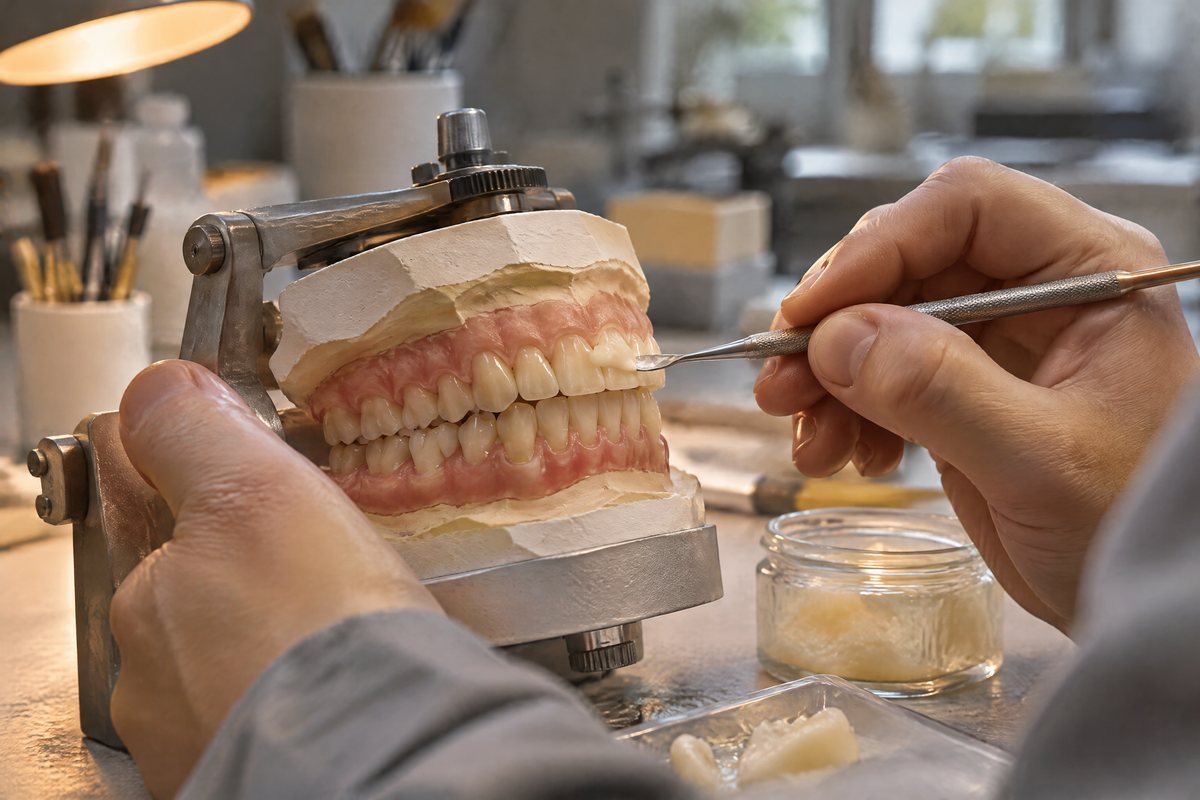
- Mock-up or trial smile. A mock-up is a physical preview made from the design (or a wax-up on a model) so that you can see and comment on the planned shape before anything permanent is done. [7]
- Health first. Decay and gum disease are treated before cosmetic steps. [3]
- Treatment in a conservative order. Whitening and tooth movement usually come before bonding, veneers or crowns, because whitening does not change the colour of existing restorations. [5]
A simulation has limits. A published review notes that the final result may not match the digital design exactly, and that patients may assume it will. [7] Shape, shade and translucency choices are covered in Niva’s article on a natural Hollywood Smile.
How long does the whole process take?
The time depends on which treatments are in the plan: from one appointment to more than a year. Using the cited patient information:
- Whitening: about an hour in the clinic, or 1 to 2 weeks at home with custom trays. [5]
- Bonding: 30 to 60 minutes per tooth, usually in a single visit. [4]
- Veneers: usually two visits. In a typical setting a dental laboratory makes the veneers over a few weeks, with temporary veneers in between if needed. [3]
- Fixed braces: 1 to 2 years, with adjustment visits every 6 to 8 weeks, then a retainer. [6]
- Gum contouring: a couple of days off work may be needed. [1]
A complete smile makeover that includes orthodontics or implants is therefore measured in months, while a plan limited to whitening and bonding can be short. Ask the clinic to put each stage and the gap between stages on a timeline.
How do you avoid over-treatment?
Over-treatment is avoided by choosing the least invasive treatment that achieves the agreed result, and by refusing to decide on the day. Over-treatment means removing more healthy tooth than the goal requires, for example placing crowns on sound teeth when whitening, alignment or veneers would do.
The reasons to be careful are practical. Veneers involve losing some natural enamel and most types cannot be reversed; crowns cover the entire tooth and are mainly intended for teeth badly damaged by decay or trauma. [3] Bonding, by contrast, typically needs no enamel removal. [4] The review of digital smile design lists the risk of over-treatment among the ethical concerns of design-led dentistry. [7]
Questions that support conservative planning:
- Which teeth are healthy, and which already need treatment for a dental reason?
- Could whitening, orthodontics or bonding achieve the change on some teeth?
- How much enamel will be removed on each tooth, and is the step reversible?
Niva’s guide on who is a suitable Hollywood Smile candidate looks at suitability in more detail.
What affects smile makeover cost?
The cost depends on the number of teeth treated, the treatments chosen, the materials, and any health treatment needed first. No single price exists because no single procedure exists. As a guide, Niva Dental’s starting prices are €260 per tooth for E-max veneers, €185 per tooth for zirconia crowns and €400 per treatment for in-clinic whitening, and a Hollywood Smile starts from €3,300 per smile with zirconia crowns or €5,200 per smile with E-max veneers; the exact total is set in a written plan after an examination.
The main factors are:
- how many teeth are included and which treatment each receives,
- material and laboratory choices for veneers and crowns,
- preparatory treatment (fillings, gum treatment, root canal treatment),
- orthodontics, implants or gum surgery, which add stages,
- planning items such as scans, design and a mock-up,
- temporaries, a night guard, retainers and follow-up visits.
Cleveland Clinic notes that dental insurance usually does not cover cosmetic services because insurers do not consider them medically necessary. [1] Restorative parts of a plan may be treated differently, so ask your insurer about each item.
What should you plan if you are travelling from abroad for a smile makeover?
Travelling for cosmetic dental work is feasible for some plans and unsuitable for others, and the difference is the number of stages. Whitening, bonding and veneers involve few appointments, whereas fixed braces need adjustments every 6 to 8 weeks for 1 to 2 years and are normally done close to home. [3][6]
- Before you book. The US Centers for Disease Control and Prevention (CDC) advises a pre-travel consultation at least 4 to 6 weeks before the trip, checking the qualifications of the clinician, and arranging how you will communicate if you do not share a language. [9]
- Assessment first. The UK General Dental Council (GDC) says you should be assessed by a qualified dentist before you are given a treatment plan and cost estimate, and that you do not have to commit that day. [8]
- Records. Send recent X-rays and a medication list in advance, and take copies of all treatment records home. [9]
- Aftercare. Ask what aftercare is provided, who you contact once you are home, and who pays for travel and remedial work if you are unhappy with the result. [8]
- Days needed. The number of days depends on the laboratory schedule; Niva’s article on how many days a Hollywood Smile in Turkey takes explains the usual stages.

What should a written treatment plan or quote include?
A written plan should describe every tooth and every stage so that you can compare clinics fairly. Ask for:
- Tooth-by-tooth list. Which treatment each tooth receives (none, whitening, bonding, veneer, crown) and why.
- Tooth preparation. How much enamel will be removed on each tooth and whether the step can be reversed.
- Materials. The material and, where relevant, the brand for veneers and crowns.
- Preview. Whether a digital design and a mock-up are included, and when you approve shape and shade.
- Health treatment first. Any fillings, gum treatment or root canal treatment, priced separately.
- Timeline. Number of visits, days per visit and the gap between stages.
- Exclusions and aftercare terms. Items not included (X-rays, temporaries, retainers, a night guard), and what happens if a restoration chips or loosens, in writing, and who you contact from home.
Frequently asked questions
How long does a complete smile makeover take?
The time depends on the treatments in the plan. Bonding takes 30 to 60 minutes per tooth and whitening about an hour in the clinic, veneers usually need two visits with laboratory work between them, and fixed braces stay on for 1 to 2 years. Ask for a written timeline that shows each stage. [3][4][5][6]
Do I need a specialist smile makeover dentist?
No single job title covers this work. Ask who will carry out each part of the plan and what their qualifications are, as the General Dental Council advises for any treatment abroad. For extensive rebuilding of all the teeth, the American College of Prosthodontists says a consultation with a prosthodontist is required and a team often works together. [2][8]
Can I rely on smile makeover before and after photos?
Before and after photos show other people’s teeth, gums and faces, so they cannot predict your result. A digital design and a mock-up made for your own mouth are more useful, although a published review notes that even these may not match the final outcome exactly. Ask to see and approve a preview before treatment. [7]
Is a cosmetic smile makeover covered by insurance?
Usually not. Cleveland Clinic states that insurance typically does not cover cosmetic dental services because insurers do not consider them medically necessary. Parts of a plan that restore damaged or missing teeth may be assessed differently, so ask your insurer about each item in the written quote before treatment starts. [1]
Should teeth be whitened before veneers or crowns?
Whitening is normally planned first, because it lightens natural teeth but does not work on fillings, crowns or veneers. If restorations are made first and the natural teeth are whitened later, the shades may no longer match. Whitening should be carried out by a registered dental professional. [5]
Discuss a smile makeover plan with Niva Dental
Niva Dental in Bakırköy, Istanbul offers composite bonding as well as veneers and crowns. If you are considering this kind of treatment there, ask for an examination, a preview of the proposed design and a written, tooth-by-tooth plan before you decide. Send recent X-rays and photographs in advance and ask which teeth could be left untouched. You can read about Hollywood Smile treatment at Niva Dental before getting in touch.
This article provides general information and cannot determine your suitability, treatment plan or costs. Consult a dentist for an individual assessment.
Medically reviewed by Dt. Efsun Esen, dentist at Niva Dental. Last reviewed: November 2026.
Medical sources
- Cleveland Clinic: Cosmetic Dentistry.
- American College of Prosthodontists: Full Mouth Reconstruction.
- Cleveland Clinic: Dental Veneers.
- Cleveland Clinic: Dental Bonding.
- Oral Health Foundation: Tooth whitening.
- NHS: Braces and orthodontics.
- Saudi Dental Journal (peer-reviewed): Integrating digital smile design into restorative dentistry: a narrative review of the applications and benefits.
- General Dental Council: Going abroad for dental treatment.
- US Centers for Disease Control and Prevention: Medical Tourism: Travel to Another Country for Medical Care.