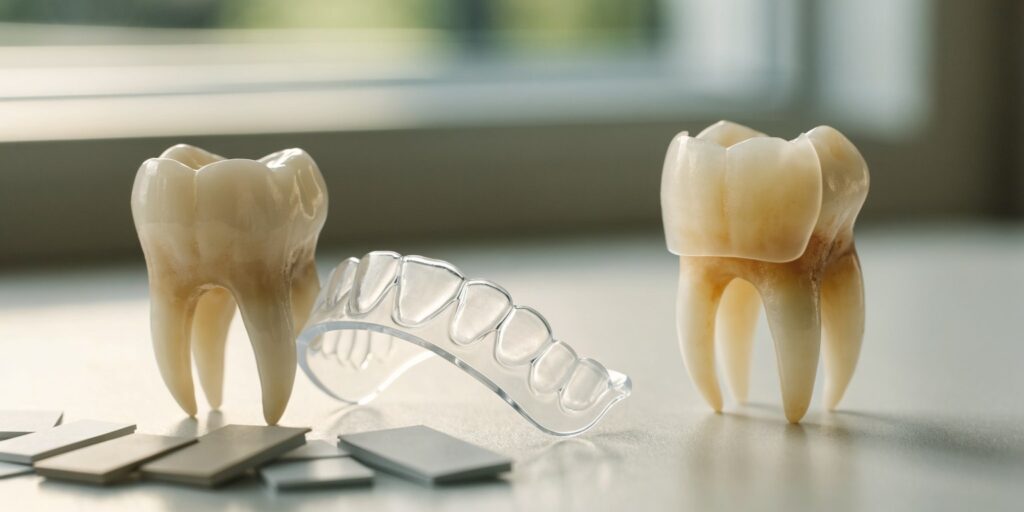


Bone graft for dental implant treatment explained: why it may be needed, material options, healing stages, risks and questions to ask before surgery.

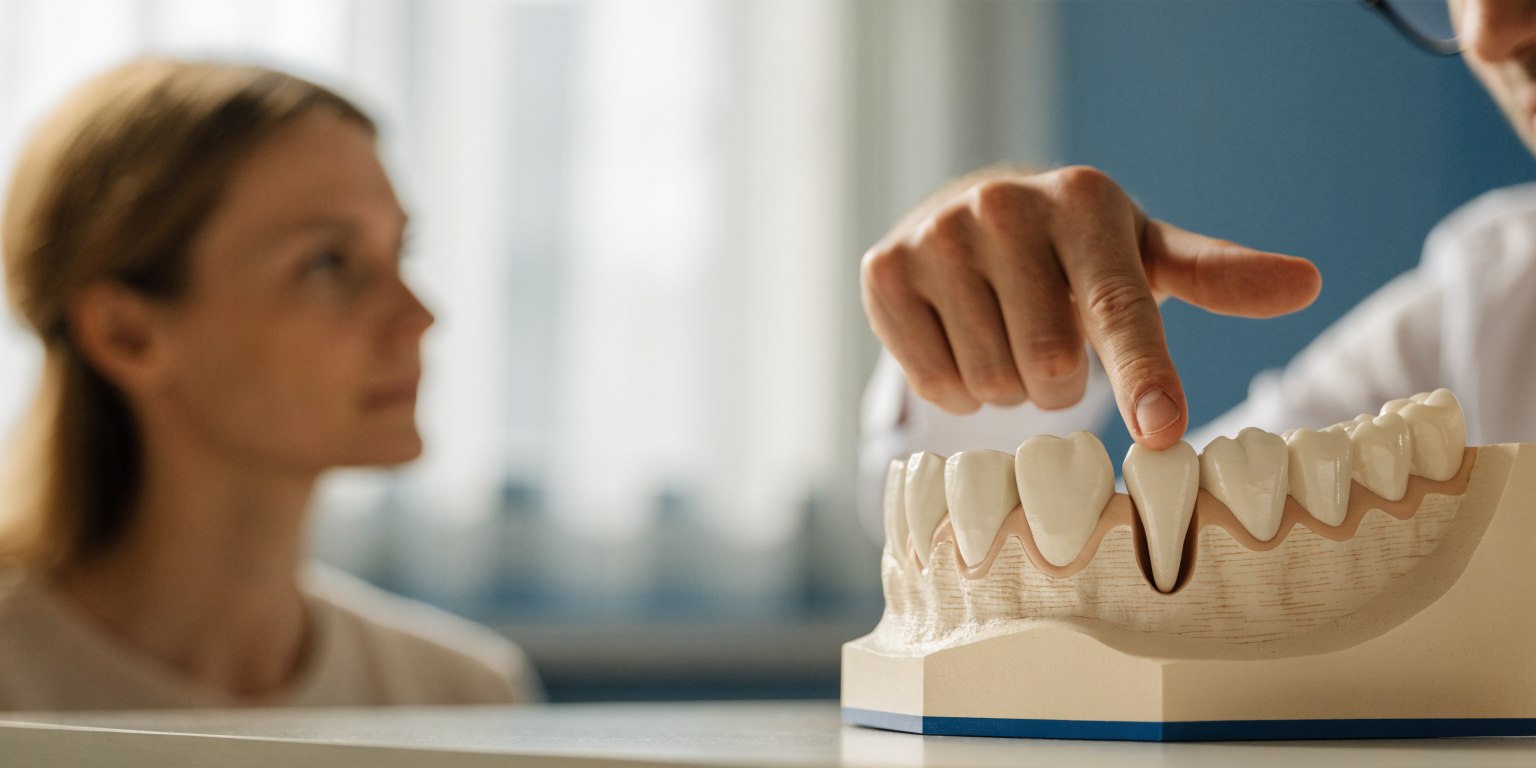
A bone graft may be recommended when the jaw does not provide enough suitable bone for the planned dental implant. It helps rebuild the supporting site; it is not necessary for every implant patient. Minor grafting can sometimes accompany implant placement, while other cases need a separate healing stage first.[1]
If you have been told you need a bone graft for dental implant treatment, ask what deficiency it addresses, which material will be used and how it changes your appointments. Feeling comfortable after surgery and having enough healed bone for the next stage are different milestones.
Why might the implant site need more bone?
An implant needs a suitable foundation in the position required for the replacement tooth. Bone can shrink after a tooth is lost or extracted.[10] Gum disease, trauma or a naturally limited ridge can also leave insufficient bone for the intended treatment.[4] Niva’s guide to dental implants with bone loss explains how reduced bone affects implant candidacy.
The decision involves more than filling an empty space. The clinician must plan where the implant and its final tooth will sit, then assess whether the available bone supports that plan.
Assessment includes an examination, medical history and appropriate imaging, which may include three-dimensional images.[1] A photograph cannot show all the underlying anatomy. Ask your clinician to explain the relevant findings on your images and whether the issue is bone width, height or another feature of the site.
How does a dental bone graft work?
A graft places bone or a bone substitute in an area that needs rebuilding. Many materials act as a scaffold that supports the growth of your own bone.[2] This is a biological healing process, not an instant replacement for mature supporting bone.
The surgeon may cover the graft with a membrane: a barrier that helps protect the space from overlying soft tissue. Some membranes dissolve; others require later removal.[2] Ask whether your plan includes a membrane, fixation screws or another component that will need a follow-up procedure.
The term “bone graft” covers procedures of different sizes. A small graft beside one implant is not equivalent to reconstruction of a large jaw defect.
Common grafting procedures
| Procedure | What it aims to address | What to clarify |
|---|---|---|
| Socket preservation | Helps maintain the bone contour after a tooth is removed | Whether it is recommended for this extraction site and future implant plan |
| Ridge augmentation | Builds up an area with insufficient jawbone | Which dimension needs rebuilding and whether treatment is staged |
| Guided bone regeneration | Uses a protected space, often with graft material and a membrane, to support bone growth | Whether it can accompany implant placement |
| Sinus augmentation, or sinus lift | Creates space for bone development beneath the sinus in the upper back jaw | The technique, timing and sinus-specific aftercare |
These approaches can overlap. For example, ridge augmentation may use guided bone regeneration. They describe the procedure rather than the source of the graft material.[3–5,10]

Where does the graft material come from?
The main sources are your own bone, processed human donor bone, animal-derived material and synthetic substitutes.[2,7] More than one material may be used in a procedure.
| Material | Source | A useful question |
|---|---|---|
| Autograft, also called autogenous bone | Bone taken from your own body | Where will it be collected, and what additional recovery does that involve? |
| Allograft | Processed human donor bone | What product and tissue source are proposed? |
| Xenograft | Material derived from another species, commonly cattle or pigs | Is the proposed product animal-derived? |
| Alloplast | A manufactured bone substitute | Why is this material suitable for the defect? |
These are material categories, not a ranking from best to worst. Ask why the selected option fits your anatomy and treatment goals. If human or animal tissue raises personal, religious or ethical concerns, discuss this before consent. The membrane may have a different source from the graft itself.[3]
Can the bone graft and implant be placed together?
Sometimes. Minor grafting may be possible during implant surgery; a larger deficiency may require grafting first and implant placement after healing.[1] The choice depends on the actual site, not simply your preferred treatment date.
The American Academy of Periodontology describes both staged and simultaneous approaches for ridge modification and sinus augmentation.[4,5] Ask which sequence is proposed and what findings during surgery could change it.
A staged plan might involve graft surgery, a healing assessment, implant placement, further healing and then the final replacement tooth. If you are travelling for treatment, clarify how that sequence translates into visits. Niva’s guide to how many trips to Turkey dental implants may require explains the planning questions.
How long does a dental bone graft take to heal?
Early recovery is usually measured in days or weeks; development of the bone needed for implant treatment takes months. The estimate depends on the graft’s size, location and technique, as well as individual healing.
Guy’s and St Thomas’ describes a three-to-six-month interval before implant treatment in many of its graft cases.[6] Larger reconstructions can take longer: Cleveland Clinic notes that some large grafts need nine to twelve months to heal.[7] Neither range is a guarantee for your case.
Early recovery and wound review
Tenderness, swelling and bruising can follow graft surgery. If bone was collected from your own body, the donor site also needs to recover.[6] Your team should explain pain control, wound care and the review schedule before you go home.
Readiness for implant placement
The review determines whether the site has healed sufficiently to proceed. Appearance or absence of pain alone cannot establish this. Ask what clinical assessment and imaging will be used, and what would cause the next stage to be postponed.
Healing after the implant is placed
If grafting and implant placement are separate, implant healing follows the graft-healing period. Osseointegration is the development of a connection between bone and the implant surface; this can take several months.[1] “The graft has healed” therefore does not necessarily mean the final tooth can be fitted immediately.

What should you expect during and after surgery?
Smaller grafting procedures can often use local anaesthetic to numb the area. Sedation may be considered separately to help with anxiety. More extensive grafting can require a different anaesthetic and care setting.[6,8]
Postoperative discomfort varies. Follow the medicine plan provided, including the dose and duration; do not add or extend medication without checking. If discomfort is not controlled, contact the treating team.[8]
Ask for written answers to these practical questions:
- When can I brush the surgical area, and is a mouth rinse prescribed?
- Which foods and chewing restrictions apply to this graft?
- Can I wear my temporary tooth or denture without disturbing the site?
- When can I return to work, exercise or driving?
- When is the wound review, and who handles urgent concerns?
Soft foods and temporary changes to denture use may be recommended after grafting.[8] Sinus surgery needs its own instructions; do not assume that advice for a small socket graft covers it.
Smoking can delay wound healing and increase the chance of graft failure.[6] Discuss support for stopping before surgery, along with your health conditions and medicines. Do not stop regular prescribed medication on your own.
What are the risks, and when should you seek help?
Potential problems include infection, opening of the wound with graft exposure, inadequate bone formation and, in some cases, graft loss. Nerve-related symptoms and sinus complications depend on the site and procedure.[3] Further treatment may be needed if the result is insufficient for the planned implant.
Contact the dental team promptly for severe or increasing pain, worsening swelling, pus or fever.[7] Also report an opening wound or persistent altered sensation rather than waiting for your next scheduled appointment.[3]
Seek emergency medical care for difficulty breathing, speaking or swallowing, substantial mouth swelling, or eye swelling with pain or changes in vision.[9] Bleeding that continues despite the pressure instructions supplied also needs emergency assessment.[8]
Questions to ask before accepting the grafting plan
A useful consultation should connect the proposed surgery to a specific finding. Ask your clinician:
- What does the examination or scan show that makes grafting advisable?
- Which procedure and material are proposed, and why?
- Can the implant be placed at the same appointment? What is the alternative plan if it cannot?
- What are the relevant risks and other treatment options for my case?
- How will readiness for the next stage be assessed?
- What does the quotation include, and what could add to the cost?
Request separate details for grafting, membranes or fixation, anaesthesia, imaging, reviews, implant placement and the final restoration. For treatment abroad, include the expected visits and arrangements for follow-up at home. An itemised plan is more useful than a package description that simply says “bone graft included.”

Frequently asked questions
Does every tooth extraction need a bone graft?
No. Socket preservation should be considered in relation to the site and future treatment plan.[10] Ask what benefit is expected in your case before agreeing to it.
Is a sinus lift the same as every other bone graft?
No. It addresses limited bone beneath the sinus in the upper back jaw. Grafting elsewhere involves different anatomy and may use a different approach.[5] See Niva’s guide to sinus lift for dental implants for more detail.
Do small granules coming out mean the graft has failed?
Not necessarily. Small particles can be shed early after some grafts. Report a large amount, or particles accompanied by worsening symptoms, and let the clinician assess the wound.[7]
Does grafting guarantee that I can have an implant?
No. Sometimes insufficient bone develops despite grafting.[3] The clinician must reassess the site before confirming the next step.
Discuss your implant plan with Niva Dental
If you are considering care at Niva Dental in Bakırköy, Istanbul, explore the clinic’s dental implant treatment information. Ask for an explanation of any proposed graft, its material source and the healing stages involved. Final recommendations require clinical assessment.
This article is for general information and does not replace a dental examination or your clinician’s postoperative instructions.
Sources
- Mayo Clinic. Dental implant surgery.
- American Association of Oral and Maxillofacial Surgeons. Bone Grafting and Membranes.
- Cambridge University Hospitals NHS Foundation Trust. Bone grafting for dental implants.
- American Academy of Periodontology. Ridge Modification.
- American Academy of Periodontology. Sinus Augmentation.
- Guy’s and St Thomas’ NHS Foundation Trust. Bone grafting for dental implants: Overview.
- Cleveland Clinic. Dental Bone Graft.
- Guy’s and St Thomas’ NHS Foundation Trust. Bone grafting for dental implants: Minor bone grafting.
- NHS. Dental abscess — urgent and emergency warning signs.
- American Association of Oral and Maxillofacial Surgeons. Preserving Bone for Dental Implants and Oral Health.