


Veneers for stained teeth may help when whitening is not enough. Compare E-max veneers, bleaching, stain types, masking limits, risks and alternatives.

Veneers for stained teeth may be appropriate when discoloration cannot be corrected predictably with more conservative treatment, especially when the patient also wants to change tooth shape, surface defects, or proportions. Teeth whitening changes the color of natural tooth structure without covering it, so it is often the more conservative first option when color is the main concern and the discoloration is likely to respond. E-max veneers can mask selected discoloration, but they do not remove the cause of staining and may require irreversible enamel preparation.
The right choice depends on why the tooth is discolored, whether the discoloration is generalized or limited to one tooth, how dark the underlying tooth is, whether existing fillings or crowns are present, and whether the tooth also needs a structural or shape correction.
Patients considering E-max veneer treatment at Niva Dental should therefore be assessed for the cause of discoloration before deciding that ceramic treatment is necessary.
Quick Answer: Veneers or Whitening for Stained Teeth?
| Situation | Whitening may be considered first | E-max veneer may be considered |
|---|---|---|
| Coffee, tea, tobacco or other external staining | Often, after dental assessment and cleaning where appropriate | Usually not first-line solely for surface staining |
| Generalized age-related yellowing | Often | If whitening does not meet the goal and other restorative indications exist |
| Mild intrinsic discoloration | May respond depending on cause | If color remains unacceptable after conservative options |
| Tetracycline staining | Mild cases may respond to prolonged dentist-supervised bleaching | More severe or resistant discoloration may require restorative masking |
| Fluorosis / white or brown enamel changes | Bleaching, microabrasion and/or resin infiltration may be appropriate in selected cases | May be considered for more severe or resistant aesthetic defects |
| One dark tooth after trauma or root canal treatment | Cause must be diagnosed; internal bleaching may be considered for a non-vital tooth | May be considered when discoloration remains or shape/structure also needs restoration |
| Existing crowns, veneers or tooth-colored fillings | Whitening will not change the restoration color | Replacement or new restorations may be needed if a mismatch remains after whitening |
| Discoloration plus chips, shape or proportion problems | Whitening corrects color only | Veneers can address color and visible contour together |
| Severe dark underlying tooth | Whitening response depends on cause | Veneer masking can be challenging and may require more opacity, thickness or another restorative approach |
The First Question: What Is Causing the Tooth Discoloration?
The cause of discoloration matters more than the word “stain.” Different color changes behave differently during whitening and require different treatment strategies.
The American Dental Association distinguishes between extrinsic and intrinsic discoloration.
Extrinsic discoloration
Extrinsic stains occur mainly on the outer tooth surface and can be associated with:
- coffee;
- tea;
- red wine;
- tobacco;
- pigmented foods and drinks;
- plaque or surface deposits;
- some mouthrinses.
Professional cleaning, stain removal and bleaching can often improve this type of discoloration, depending on the cause.
Intrinsic discoloration
Intrinsic discoloration occurs within enamel or dentin and may be associated with:
- aging;
- developmental conditions;
- fluorosis;
- tetracycline exposure during tooth development;
- trauma;
- pulpal bleeding or necrosis;
- previous restorative materials;
- root canal treatment;
- changes in enamel and dentin over time.
Importantly, intrinsic does not automatically mean “whitening cannot work.” The ADA notes that whitening can affect both extrinsic and some intrinsic staining, but response varies substantially according to the cause and tooth color.
This is why a dental examination should come before selecting either whitening or veneers.
What Does Teeth Whitening Actually Do?
Teeth whitening changes the color of natural teeth using bleaching agents such as hydrogen peroxide or carbamide peroxide. It does not change tooth shape, repair chips, close gaps, or reposition teeth.
According to the ADA, peroxide-based whitening agents can permeate dental hard tissues and break down colored molecules.
Whitening options can include:
- in-office bleaching;
- dentist-supervised take-home trays;
- selected over-the-counter whitening products;
- stain-removal toothpastes for mainly superficial staining.
The most important limitation is that not every type of discoloration responds equally.
The ADA’s MouthHealthy guidance notes that yellow teeth often respond better than brown or gray teeth and that discoloration related to medications or tooth injury may respond poorly to conventional whitening.
Whitening also affects only natural tooth structure.
Crowns, veneers and fillings do not whiten like enamel, which can create a visible mismatch if natural teeth are lightened around existing restorations.
Common whitening side effects
The ADA identifies temporary tooth sensitivity and gingival irritation as the most common adverse effects of vital tooth whitening.
These effects are usually temporary, but treatment should still be individualized, particularly for patients who already have sensitivity, exposed root surfaces or oral-health problems.
What Do E-max Veneers Do Differently?
E-max veneers change the visible surface of the tooth rather than bleaching the tooth from within. They can therefore alter color, shape, proportion, surface texture and selected minor contour irregularities at the same time.
A veneer is a restoration type.
E-max / IPS e.max is ceramic material-system terminology. IPS e.max CAD and IPS e.max Press use lithium-disilicate glass-ceramic and can be used for several restoration designs, including veneers when clinically indicated.
For stained teeth, an E-max veneer may be considered when:
- discoloration remains after reasonable conservative treatment;
- the tooth also has chips or shape defects;
- several visible teeth require a coordinated color and contour change;
- the underlying tooth can support a bonded ceramic restoration;
- adequate aesthetic masking is possible without excessive preparation.
However, veneers should not be treated as “permanent whitening.”
Prepared ceramic veneer treatment is irreversible when enamel is removed, and the restoration may eventually need repair or replacement.
Veneers vs Whitening: What Is the Main Difference?
| Decision Factor | Teeth Whitening | E-max Veneers |
|---|---|---|
| Main goal | Lighten natural tooth color | Cover the visible tooth surface and change color/shape |
| Removes or masks stain? | Chemically changes tooth color | Masks underlying color with ceramic |
| Changes tooth shape? | No | Yes |
| Repairs chips? | No | Can in selected cases |
| Tooth preparation | No veneer preparation | Often some enamel preparation; amount varies |
| Reversibility | Does not involve removing enamel for a restoration | Irreversible if tooth structure is removed |
| Works on crowns/fillings/veneers? | No | New restoration can be shade-matched to the treatment plan |
| Best for | Color-only concerns that are likely to respond | Resistant discoloration plus restorative/aesthetic indications |
| Main limitations | Variable response, sensitivity, relapse/re-staining, existing restorations do not whiten | Preparation, bonding risks, fracture/debonding, masking limits, future replacement |
| Universal winner | No | No |
The most conservative approach is generally to treat color with color-changing treatment first when that treatment is likely to work, then use restorative treatment only for problems that remain.
When Is Whitening Usually the More Conservative First Option?
Whitening is usually the more conservative first option when the teeth are healthy, color is the main complaint, and the discoloration is expected to respond to bleaching.
This may include selected patients with:
- generalized yellowing;
- age-related darkening;
- food and beverage staining;
- tobacco staining;
- mild intrinsic color changes;
- natural teeth that are otherwise well shaped and aligned.
Whitening preserves natural tooth structure because it does not require covering the facial surface with ceramic.
That does not mean every stained tooth should be bleached.
A dentist should first rule out:
- caries;
- leaking restorations;
- trauma;
- pulpal disease;
- a non-vital tooth;
- enamel defects;
- significant gum disease;
- and other causes of a new or unusual color change.
A single tooth that suddenly becomes dark is especially different from generalized coffee staining and should not be self-treated simply as a cosmetic problem.
When Might E-max Veneers Be More Appropriate for Discoloration?
E-max veneers may be more appropriate when discoloration is resistant to conservative options or when the tooth also needs a lasting change in shape, surface or proportion.
Potential situations include selected cases of:
- severe or uneven intrinsic discoloration;
- persistent tetracycline banding;
- a dark tooth that remains unacceptable after appropriate internal or external bleaching;
- enamel defects combined with color problems;
- discoloration plus chips or worn edges;
- multiple existing aesthetic problems on the same visible teeth.
The clinical question should still be:
“Can this color problem be improved adequately with a less invasive treatment?”
If the answer is yes, whitening, microabrasion, resin infiltration or composite bonding may deserve consideration before ceramic.
If the answer is no, the dentist can then evaluate whether a veneer can mask the color without creating an overbulked or excessively opaque restoration.
Can E-max Veneers Hide Very Dark Teeth?
Sometimes, but severe discoloration is one of the most difficult situations for a thin translucent ceramic veneer.
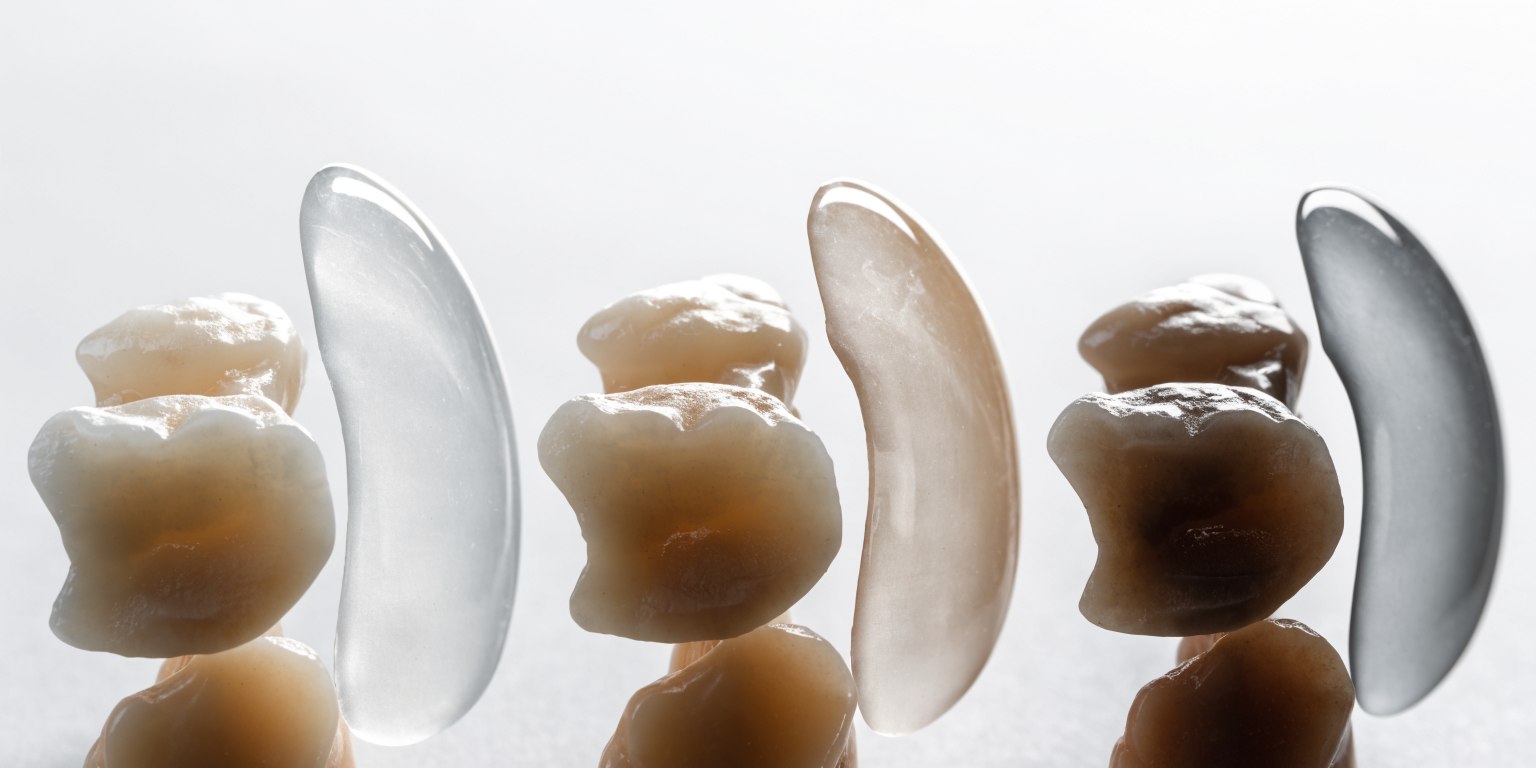
A 2025 laboratory study evaluated lithium-disilicate veneers with different ceramic translucencies and resin cement shades over normal and severely discolored substrates.
In that experimental model:
- underlying substrate shade was the dominant factor affecting final color;
- ceramic translucency also influenced the result;
- resin cement shade had a smaller but measurable effect;
- none of the tested combinations achieved the study’s clinically acceptable masking threshold for the severely discolored group.
This should not be interpreted as “E-max cannot be used on dark teeth.”
It means material choice alone is not enough.
The dentist and technician may need to consider:
- the cause of discoloration;
- the actual substrate color;
- ceramic opacity;
- veneer thickness;
- preparation design;
- resin cement;
- whether the underlying tooth should be treated first;
- and whether another restoration type is more appropriate.
For the detailed optical discussion, see Can E-max Veneers Look Natural? Shade, Shape and Translucency Explained.
What About Tetracycline-Stained Teeth?
Tetracycline staining does not automatically require veneers. Mild cases may respond to prolonged dentist-supervised bleaching, while severe or resistant cases may need restorative masking.
A 2024 literature review on tetracycline staining concluded that bleaching should be the first treatment option for low-grade cases and that restorative procedures may be indicated for more severe staining.
This is more nuanced than many cosmetic pages suggest.
Conventional short whitening courses may provide limited change in more severe tetracycline discoloration, and the treatment period needed for improvement can be much longer than for ordinary surface staining.
If the patient still has unacceptable banding or discoloration after conservative treatment, veneer treatment may then be discussed.
The restorative plan must also consider that a dark tooth underneath a thin ceramic veneer can influence the final shade.
What About Fluorosis and White or Brown Enamel Spots?
Fluorosis does not automatically require veneers. Bleaching, microabrasion and resin infiltration can improve selected mild-to-moderate fluorosis while preserving more natural tooth structure.
A 2024 systematic review and meta-analysis found that bleaching and resin infiltration can improve the appearance of fluorotic anterior teeth, with combined approaches showing favorable masking in the included evidence.
A 2025 systematic review and meta-analysis of randomized trials also found resin infiltration effective for aesthetic masking of dental fluorosis compared with other minimally invasive techniques, although certainty varied by outcome.
Depending on the type and severity of fluorosis, options may include:
- bleaching;
- enamel microabrasion;
- resin infiltration;
- combined minimally invasive treatment;
- composite restoration;
- ceramic veneer for selected more severe or resistant cases.
This is an important reason not to label every mottled or spotted tooth as a “veneer case” from a photograph.
What If One Tooth Is Dark After Trauma or Root Canal Treatment?
A single dark tooth needs diagnosis before cosmetic coverage. Trauma, pulpal breakdown, previous root canal treatment and restorative materials can all change tooth color.
For a non-vital or root-canal-treated tooth, internal bleaching may be considered when clinically appropriate.
If the color remains unacceptable, or if the tooth also requires shape or structural restoration, a veneer or crown may be considered depending on the remaining tooth structure.
A crown should not be selected automatically simply because the tooth is dark.
Likewise, a veneer should not be selected automatically if the tooth is structurally compromised and requires more extensive protection.
For restoration-design differences, see E-max Veneers vs Crowns: What Is the Difference?.
Should You Whiten Before Getting E-max Veneers?
Often, yes—especially when only some visible teeth will receive veneers and the remaining natural teeth can be lightened first.
Whitening natural teeth before final veneer shade selection may help:
- reduce the shade difference between treated and untreated teeth;
- allow a more natural ceramic shade;
- reduce the need to veneer additional healthy teeth solely for color matching;
- establish the final shade of natural teeth before the ceramic is fabricated.
However, whitening and bonding should be properly sequenced.
A 2024 study found that bleaching temporarily reduced immediate enamel bond strength, with the largest reduction when bonding occurred one day after bleaching. In that study, recovery occurred after a short delay.
The exact waiting period should be determined by the treating dentist according to:
- whitening method;
- adhesive protocol;
- restorative material;
- tooth condition;
- and the clinical evidence used.
This article therefore does not recommend an automatic fixed number of days for every patient.
For broader tooth-count planning, see How Many E-max Veneers Do You Need: 6, 8, 10 or More?.
Can Whitening Damage or Change Existing Veneers?
Whitening products do not lighten ceramic veneers the way they lighten natural enamel. This can create a visible mismatch between whitened natural teeth and existing restorations.
The ADA specifically advises patients that tooth-colored restorations—including crowns and other restorations—do not change color like natural teeth during bleaching.
Patients with existing veneers should therefore discuss:
- which teeth are natural;
- which teeth are restored;
- the current shade of each restoration;
- whether whitening is likely to create a mismatch;
- whether any restoration may need polishing, repair or replacement afterward.
Whitening should not be used in an attempt to bleach an E-max veneer itself.
What Are the Risks and Limitations of Whitening?
Whitening is conservative, but it is not completely free of side effects or limitations.
Potential issues include:
- temporary tooth sensitivity;
- gingival irritation;
- uneven results;
- poor response in some discoloration types;
- mismatch with crowns, veneers and fillings;
- color relapse or future re-staining;
- unrealistic expectations regarding how white natural teeth can become.
The ADA recommends dental assessment before bleaching so that the cause of discoloration and oral-health considerations can be evaluated.
A whitening product should not be used to hide symptoms such as unexplained single-tooth darkening, pain, decay or dental trauma.
What Are the Risks and Limitations of E-max Veneers?
E-max veneers can provide controlled restorative masking, but the treatment creates a greater long-term biological and restorative commitment than whitening.
Potential considerations include:
- irreversible enamel removal when preparation is performed;
- temporary or persistent sensitivity;
- dentin exposure;
- fracture or chipping;
- debonding;
- marginal discoloration;
- gum irritation;
- secondary decay;
- shade mismatch with untreated teeth;
- inability to mask severe discoloration with an overly thin/translucent design;
- future repair or replacement.
The ADA’s veneer guidance notes that decay and gum disease should be treated before veneers and that veneers can chip, crack, loosen or eventually require repair or replacement.
For preparation and irreversibility, see Do E-max Veneers Require Tooth Shaving? What Patients Should Know.
What Other Conservative Treatments Can Improve Stained Teeth?
Whitening and veneers are not the only options. The most appropriate treatment depends on the type, depth and distribution of discoloration.
Potential alternatives include:
Professional cleaning and polishing
Useful for removable surface deposits and extrinsic staining.
Enamel microabrasion
May be used for selected superficial enamel discoloration or fluorosis.
Resin infiltration
Current evidence supports its use in selected white-spot lesions and mild-to-moderate fluorosis.
Composite bonding or composite veneers
Can mask selected localized discoloration while also correcting small shape defects. Composite is generally easier to repair than ceramic, although its long-term color stability and maintenance profile differ.
See E-max Veneers vs Composite Bonding: Which Is Better for Your Teeth?.
Internal bleaching
May be appropriate for selected non-vital or root-canal-treated discolored teeth.
Observation / no treatment
If the tooth is healthy and the concern is purely cosmetic, choosing no treatment is also valid.
A conservative plan should compare these options before irreversible ceramic preparation.
What Should International Patients Ask Before Choosing Veneers for Stained Teeth in Turkey?
International patients should ask the clinic to diagnose the discoloration before recommending a fixed number of veneers or a cosmetic package.
Useful questions include:
- What is the likely cause of my discoloration?
- Is it mainly extrinsic, intrinsic, developmental or related to a non-vital tooth?
- Can professional cleaning or whitening improve it?
- If whitening is recommended, which teeth are expected to respond?
- Are any existing fillings, crowns or veneers likely to create a color mismatch?
- Could microabrasion or resin infiltration be appropriate?
- If one tooth is dark, should it be assessed for trauma, pulpal disease or previous root canal treatment?
- If veneers are proposed, why is ceramic preferable to a more conservative option?
- How dark is the underlying tooth substrate?
- What ceramic translucency or opacity may be needed?
- How much enamel preparation is expected?
- Should whitening be completed before final veneer shade selection?
- How will the untreated teeth be matched?
- What happens if the discoloration cannot be masked with a conservative veneer thickness?
Niva Dental is located in Bakırköy, Istanbul and currently lists E-max veneers among its dental treatment areas. Niva’s Hollywood Smile guidance also presents whitening, bonding, veneers, crowns and orthodontics as different possible parts of individualized smile planning rather than one fixed procedure.
Patients traveling for treatment can review the Niva Dental patient journey for broader consultation and travel planning.
Veneers for Stained Teeth: A Practical Decision Framework
For veneers for stained teeth, use this sequence:
1. Diagnose the discoloration
Determine whether the problem is surface staining, intrinsic discoloration, fluorosis, medication-related staining, trauma, a non-vital tooth, aging or an existing restoration.
2. Treat disease first
Decay, gum disease, pulpal disease or other dental pathology should be addressed before elective cosmetic treatment.
3. Start with the least invasive effective option
If whitening, cleaning, microabrasion, resin infiltration or internal bleaching is likely to solve the problem, those options deserve consideration before ceramic veneers.
4. Reassess the residual problem
After conservative treatment, determine whether unacceptable discoloration remains and whether shape, surface or structural concerns are also present.
5. Evaluate whether a veneer can mask the substrate conservatively
A severely dark tooth may require more opacity, thickness or preparation than a typical translucent veneer.
6. Choose the restoration based on the tooth—not the package
Some teeth may need no restoration. Others may need bonding, a veneer or a crown depending on structure and aesthetic needs.
Whitening changes the tooth’s color. Veneers cover the tooth’s visible surface. The correct choice depends on what is causing the discoloration and how much treatment is actually necessary.
Frequently Asked Questions
Are veneers better than whitening for stained teeth?
Not always. Whitening is usually more conservative when the main problem is tooth color and the discoloration is expected to respond. Veneers may be considered when staining is resistant, severe, uneven or combined with shape and surface problems. Diagnosis of the discoloration should come before choosing either treatment.
Can E-max veneers cover yellow teeth?
They can mask selected yellow or discolored teeth, but a veneer may be unnecessary if whitening can achieve an acceptable color change. If ceramic treatment is considered, the dentist must assess the starting tooth shade, veneer thickness, translucency, enamel and whether untreated neighboring teeth will remain visible.
Can E-max veneers cover tetracycline stains?
They may be able to mask tetracycline discoloration, but low-grade cases may first be treated with prolonged dentist-supervised bleaching. Severe banding can be difficult to mask with thin highly translucent ceramic, so opacity, thickness, preparation and the underlying tooth color require careful planning.
Is whitening useless for tetracycline-stained teeth?
No. Tetracycline discoloration can be resistant to ordinary short whitening protocols, but literature reviews indicate that prolonged professional bleaching can improve selected low-grade cases. The response varies with severity and distribution. Restorative treatment may be considered when conservative bleaching does not provide an acceptable result.
Can fluorosis be treated without veneers?
Yes, in selected cases. Current systematic reviews support conservative approaches such as bleaching, microabrasion and resin infiltration for mild-to-moderate dental fluorosis. The appropriate treatment depends on lesion color, depth, distribution and patient goals. Ceramic veneers should not automatically be the first treatment for fluorosis.
Should I whiten my teeth before getting veneers?
Often, especially when some natural teeth will remain untreated. Whitening first can establish the lighter shade of natural teeth before final veneer color is selected. Because bleaching can temporarily influence enamel bonding, the dentist should also plan an appropriate interval and adhesive protocol before veneer bonding.
Can I whiten E-max veneers after they are fitted?
No. Bleaching agents do not lighten ceramic veneers the way they lighten natural enamel. If surrounding natural teeth are whitened later, a shade mismatch can develop. This is why whitening goals are usually considered before final ceramic shade selection when only some teeth will receive veneers.
What if only one front tooth is dark?
A single dark tooth should be diagnosed before it is covered. Trauma, pulpal changes, root canal treatment or existing restorative materials may be involved. Internal bleaching may be an option for selected non-vital teeth. A veneer or crown may be considered if color, shape or structural problems remain.
Can whitening make my teeth sensitive?
Yes. Temporary tooth sensitivity and gum irritation are the most commonly reported side effects of vital tooth whitening. The risk and intensity vary by product, concentration, treatment protocol and individual sensitivity. A dentist can assess whether whitening is appropriate and modify the approach when needed.
What if whitening does not work?
Failure to reach the desired shade does not automatically mean you need veneers. The dentist should reassess the cause of discoloration and consider whether a longer whitening protocol, internal bleaching, microabrasion, resin infiltration, composite bonding or another treatment is appropriate before recommending irreversible ceramic treatment.
Patients deciding between whitening and E-max veneers for stained teeth can contact Niva Dental in Bakırköy, Istanbul for an initial assessment of the cause and severity of discoloration, existing restorations, enamel, gum health and aesthetic goals. Final treatment may involve whitening, another conservative technique, veneers or a combination; suitability should be confirmed after an individual dental examination.
Medical References and Sources
| Source | What It Supports |
|---|---|
| American Dental Association — Whitening | Extrinsic and intrinsic discoloration, hydrogen/carbamide peroxide, existing restorations not whitening, need for dental assessment, and common adverse effects such as sensitivity and gingival irritation. |
| American Dental Association / MouthHealthy — Teeth Whitening | Variation in whitening response by tooth color/cause; whitening does not change veneers, crowns or fillings; medication- or injury-related discoloration may respond poorly. |
| American Dental Association / MouthHealthy — Veneers | Veneer purpose, enamel preparation/irreversibility, oral-health prerequisites, and future repair/replacement considerations. |
| Wayakanon K, et al. — Masking discolored substrates with lithium disilicate veneers and resin cements — PMID 40825404 | 2025 quantitative evidence showing strong influence of underlying substrate color and additional effects of ceramic translucency and cement shade on masking severe discoloration. |
| Wittich FK, et al. — Masking efficacy of bleaching and/or resin infiltration of fluorotic spots — PMID 39103078 | 2024 systematic review/meta-analysis supporting bleaching and resin infiltration as conservative options for fluorotic anterior teeth. |
| Han H, et al. — Resin Infiltration for Dental Fluorosis — PMID 40878777 | 2025 systematic review/meta-analysis supporting resin infiltration for aesthetic masking of mild-to-moderate fluorosis. |
| Tetracycline staining of the dentition: a review of the literature — PMID 38640005 | Supports prolonged bleaching as a first option for selected low-grade tetracycline staining and restorative treatment for severe cases. |
| Bleaching effect on bonding performance of composite to enamel — PMID 38837858 | 2024 evidence that enamel bond strength can be temporarily reduced immediately after bleaching, supporting deliberate sequencing before bonded restorative treatment. |