


Can Emax veneers break? Learn why veneers may chip, crack or come off, what raises the risk, what to do next, and when repair or replacement may be needed.

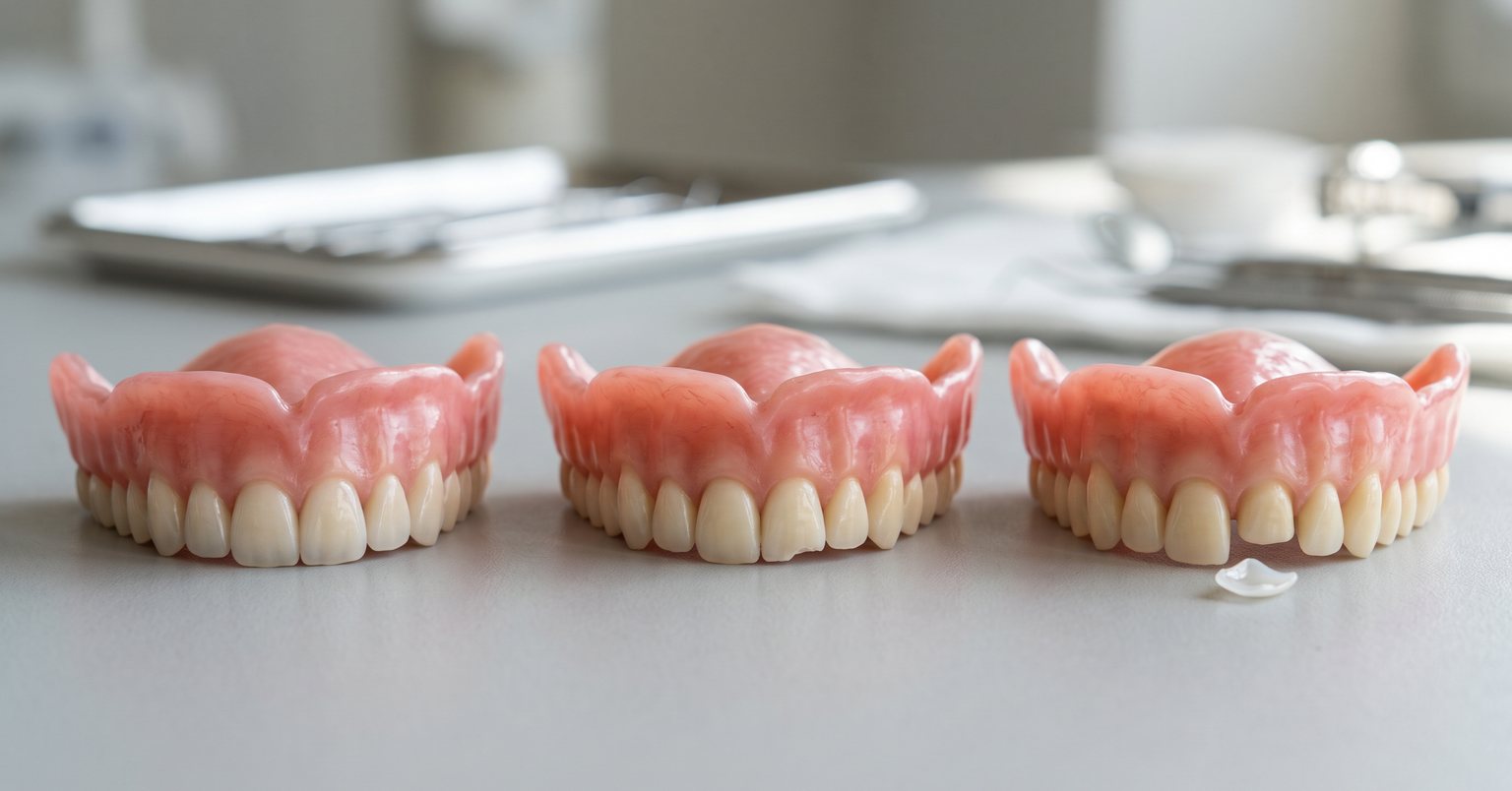
Can Emax veneers break? Yes. E-max / lithium-disilicate veneers can chip, fracture or debond, even though long-term clinical studies report high survival when ceramic veneers are appropriately selected and bonded. A veneer that “falls off” is usually a different type of problem from a veneer that breaks: fracture means the ceramic has cracked or separated, while debonding means the veneer has lost its attachment to the tooth.
The risk is influenced by the condition of the tooth, how much enamel remains, bonding conditions, bite forces, grinding or clenching, trauma, preparation design, and long-term maintenance. No ceramic veneer should be described as unbreakable or permanent.
Patients considering E-max veneer treatment at Niva Dental should have these risks discussed before irreversible treatment is started.
Quick Answer: Can E-max Veneers Chip, Break or Fall Off?
| Problem | What it means | What may happen next |
|---|---|---|
| Small chip | A limited piece of ceramic has fractured, often near an edge | May be polished or repaired in selected cases; larger defects may need replacement |
| Crack | A fracture line has developed in the ceramic | Requires dental assessment; treatment depends on crack depth, stability and tooth condition |
| Complete fracture | The veneer has broken into a larger piece or pieces | Replacement is often considered if repair cannot restore strength, fit or aesthetics |
| Debonding / veneer comes off | The veneer separates from the tooth without necessarily breaking | An intact veneer may sometimes be rebonded after the cause is assessed |
| Repeated debonding | A veneer comes off more than once | The dentist should investigate bonding substrate, preparation, fit, bite and other underlying causes |
| Pain or sensitivity after breakage | The underlying tooth may be exposed or injured | Prompt dental review is important |
| Loose veneer | The bond may be failing or the restoration may be partially detached | Avoid biting on it and arrange dental assessment |
How Often Do Ceramic Veneers Break or Develop Complications?
Modern ceramic veneers generally show high survival, but high survival does not mean zero complications.
A 2025 systematic review and meta-analysis evaluated 29 clinical studies of ceramic laminate veneers. For lithium-disilicate veneers, the pooled survival rate was 96.81% at an average follow-up of approximately 10.4 years. The same analysis estimated a 6.1% technical complication rate for lithium-disilicate veneers at that long-term observation point.
Technical complications can include events such as fracture, chipping or loss of retention, depending on how each clinical study defines outcomes.
A separate systematic review of 6,500 porcelain laminate veneers reported an estimated 95.5% cumulative survival at 10 years. In that review, fracture was the most frequently identified cause of failure, followed by debonding.
These results should not be turned into a promise that an individual veneer has a 96% chance of lasting a specific number of years. Clinical studies combine different patients, materials, preparation designs, bonding systems, dentists and follow-up periods.
The useful takeaway is:
Ceramic veneers are long-term restorations with generally high survival, but fracture and debonding are real complications that patients should understand.
What Is the Difference Between Chipping, Breaking and Falling Off?
Chipping, fracture and debonding are different failure modes and may require different treatment.
Chipping
A chip is a small localized loss of ceramic.
It may occur at:
- the incisal edge;
- a corner;
- a thin ceramic area;
- or a region exposed to repeated contact.
A tiny chip does not automatically mean the entire veneer must be replaced. Depending on its size, location, aesthetics and bite, the dentist may consider smoothing, polishing or repair.
Fracture
A fracture is a more substantial crack or break in the ceramic.
A fractured veneer may:
- remain partly attached;
- split through the ceramic;
- lose a large segment;
- or become unsuitable for repair.
Replacement is more likely when the fracture compromises structural integrity, margin quality or aesthetics.
Debonding
Debonding means the veneer separates from the tooth at the bonded interface.
The ceramic can sometimes remain intact.
This is why a patient who says, “My veneer fell off,” may not actually have a broken veneer.
If the veneer is undamaged and the tooth remains suitable, rebonding may be possible in selected cases. The dentist must first determine why it detached.
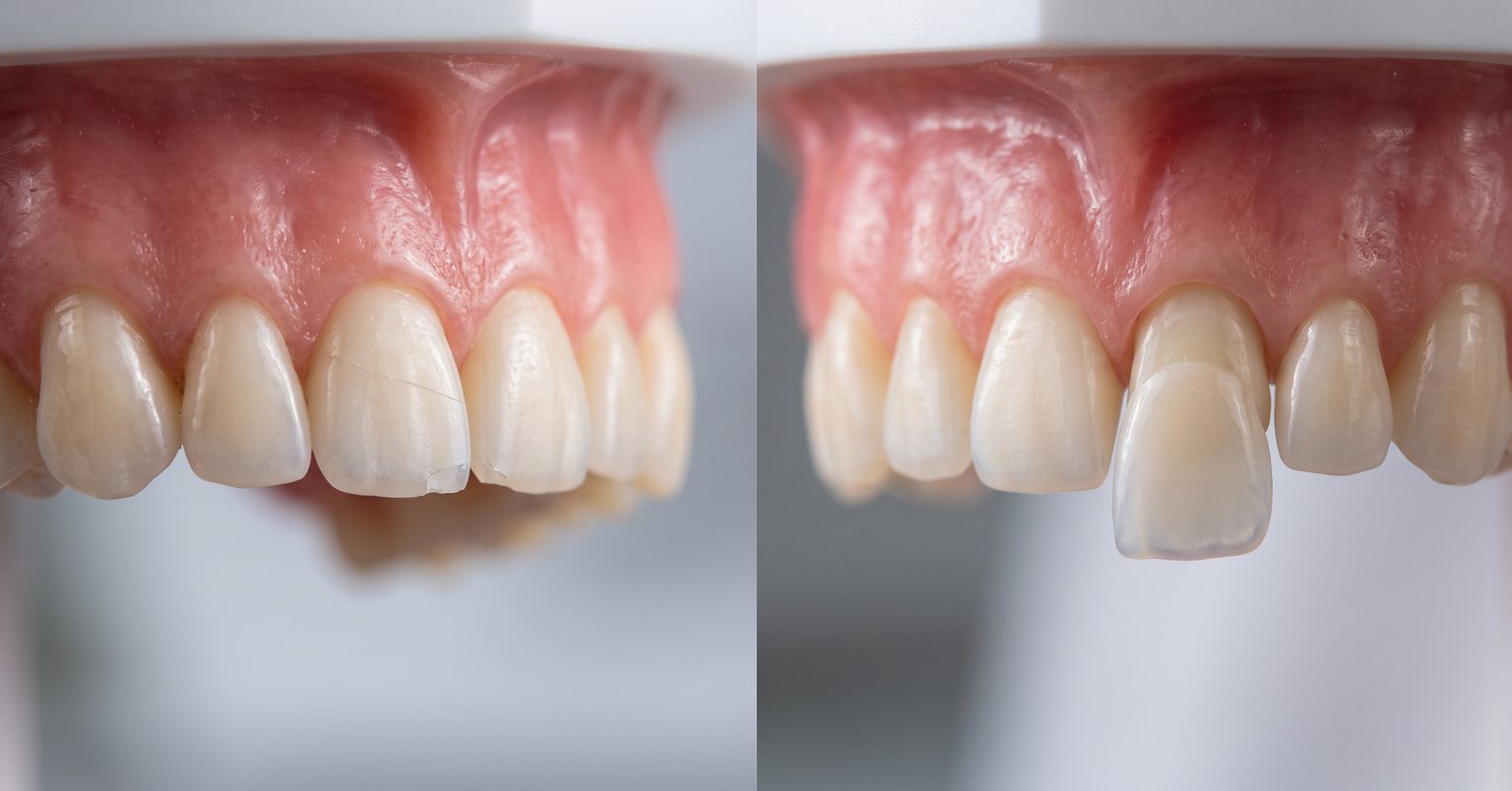
Why Can an E-max Veneer Break?
An E-max veneer can break when the forces acting on the restoration exceed what the tooth–bond–ceramic system can tolerate. Material strength is only one part of that system.
Possible contributing factors include:
- excessive bite force;
- tooth grinding or clenching;
- direct trauma;
- biting very hard objects;
- unfavorable tooth position;
- insufficient restorative space;
- excessive or uneven ceramic thickness;
- unsupported ceramic edges;
- an unfavorable preparation design;
- inadequate bonding conditions;
- loss of supporting tooth structure;
- changes in the bite over time.
A ceramic veneer works by being adhesively integrated with the underlying tooth.
The restoration should therefore not be evaluated as a free-standing piece of ceramic.
The tooth substrate, resin cement, enamel or dentin, preparation geometry and occlusal forces all interact.
Why Can a Veneer Fall Off Without Breaking?
A veneer can come off even when the ceramic itself remains intact because retention depends on the adhesive bond between the veneer and the tooth.
Possible contributing factors can include:
- contamination during bonding;
- an unfavorable bonding substrate;
- excessive dentin exposure;
- inadequate enamel;
- fit or cementation problems;
- repeated heavy functional or parafunctional forces;
- trauma;
- deterioration at the bonded interface;
- a change in the underlying tooth.
Current evidence supports the importance of enamel preservation.
A 2025 retrospective clinical study followed 672 ceramic veneers for 1 to 15 years. Estimated survival was 96.7% for veneers bonded to enamel-only preparations, compared with 93.9% when more than 30% of the bonding surface involved dentin. Greater dentin exposure was associated with higher failure risk.
This does not mean that a veneer bonded partly to dentin will fail.
It does mean that unnecessary enamel removal can reduce the quality of the bonding environment, which is one reason conservative preparation matters.
For a dedicated discussion, see Do E-max Veneers Require Tooth Shaving? What Patients Should Know.
Does Bruxism Make E-max Veneers More Likely to Break?
Grinding or clenching can increase concern about veneer fracture, chipping and debonding, but the exact individual risk cannot be predicted from the current evidence alone.
The American Dental Association notes that patients who clench or grind their teeth, or who have a deep overbite, may not be good veneer candidates without further assessment.
A systematic review and meta-analysis evaluating sleep bruxism and ceramic restoration failure found a signal of higher risk in the subgroup of anterior ceramic veneers. However, the authors rated the overall evidence as very low quality, with substantial clinical and methodological limitations.
That means it would be inaccurate to say:
“Bruxism always causes veneers to break.”
It would also be inaccurate to ignore bruxism.
Before veneer treatment, the dentist may assess:
- tooth wear;
- chipped natural teeth;
- previous restoration fractures;
- bite contacts;
- jaw-muscle symptoms;
- clenching or grinding history;
- deep bite;
- edge-to-edge contacts.
A protective night guard may be considered for selected patients. A guard does not guarantee that a veneer cannot fracture, and it does not eliminate the underlying bruxism.
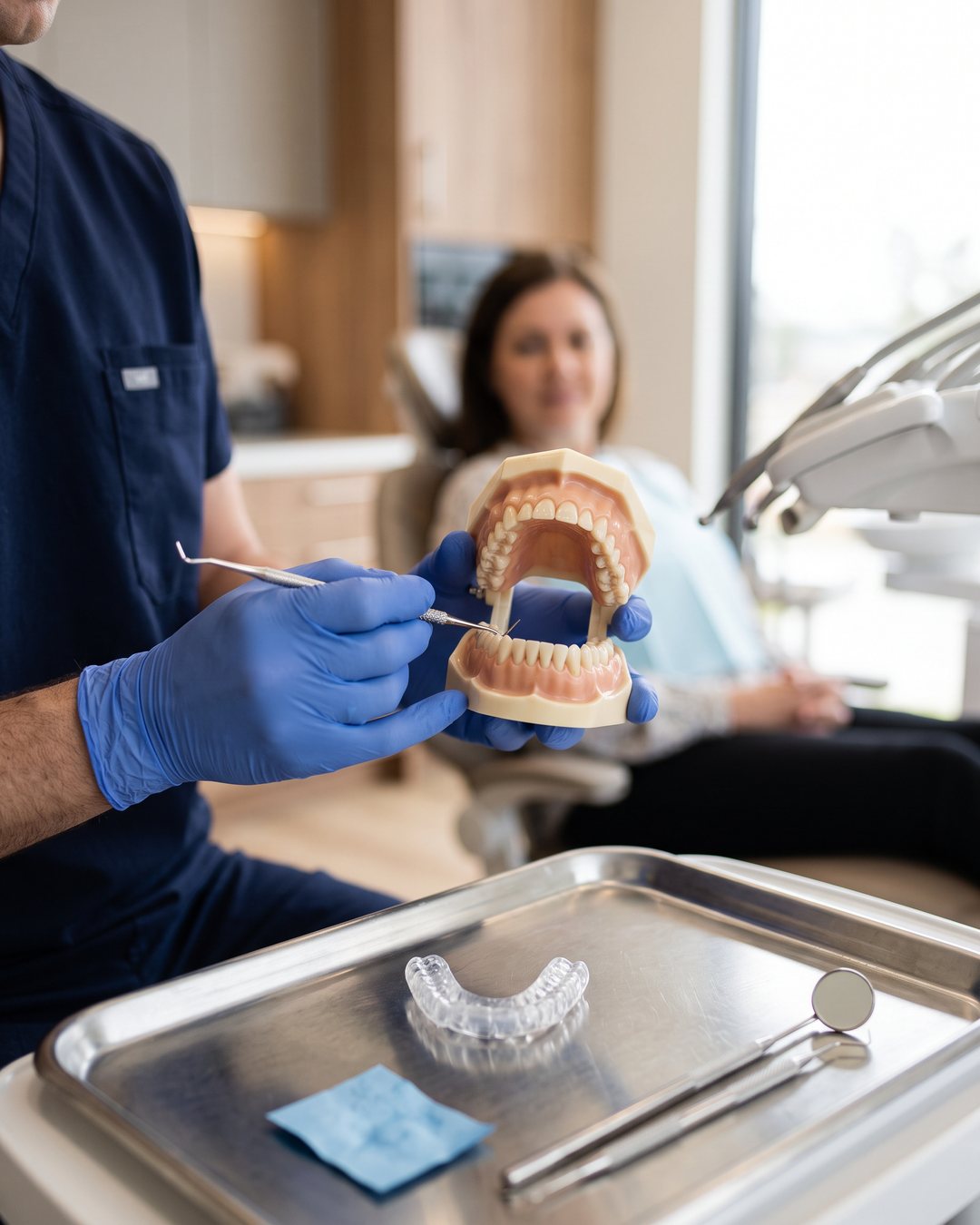
Can Hard Foods or Using Teeth as Tools Break Veneers?
Yes. Concentrated forces from very hard objects or non-food habits can damage ceramic veneers and natural teeth.
The ADA advises patients with veneers to avoid habits such as:
- biting fingernails;
- chewing hard objects;
- and using the teeth in ways that expose restorations to unnecessary force.
Examples include:
- chewing ice;
- biting pens;
- cracking hard shells with front teeth;
- opening packaging with the teeth;
- biting directly onto unexpectedly hard food items.
This does not mean patients with veneers must eat only soft foods.
It means restored front teeth should not be used as mechanical tools.
For sports or activities with a risk of facial injury, the ADA also recommends appropriate mouth protection.
Can the Tooth Under the Veneer Cause the Veneer to Fail?
Yes. A veneer depends on the health and stability of the tooth underneath it.
A ceramic restoration does not protect the natural tooth from every biological problem.
The ADA notes that patients can still develop decay around or under a veneer.
Problems that can compromise the veneer or require treatment include:
- new decay;
- progression of an existing crack;
- loss of tooth structure;
- gum disease;
- trauma;
- pulpal or endodontic problems;
- changes in an old filling beneath or beside the veneer.
A veneer that repeatedly comes off should not simply be rebonded again and again without investigating the tooth and bite.
Sometimes the problem is not the ceramic.
It may be the underlying tooth or the environment supporting the restoration.
Does E-max Material Make Veneers Unbreakable?
No. Lithium disilicate is a well-established dental ceramic, but no dental ceramic is unbreakable.
IPS e.max CAD is a lithium-disilicate glass-ceramic used for several indirect restoration types, including veneers in appropriate cases. Manufacturer documentation describes high flexural strength and fracture toughness, but those laboratory material properties do not translate into a guarantee that a thin veneer cannot chip or debond clinically.
Clinical performance depends on:
- material;
- ceramic thickness;
- tooth preparation;
- bonding;
- enamel availability;
- restoration design;
- bite;
- habits;
- trauma;
- maintenance.
A strong ceramic on a poor foundation can still fail.
Similarly, a properly selected and bonded thin veneer can perform well despite being much thinner than a crown because it functions as part of a bonded restorative system.
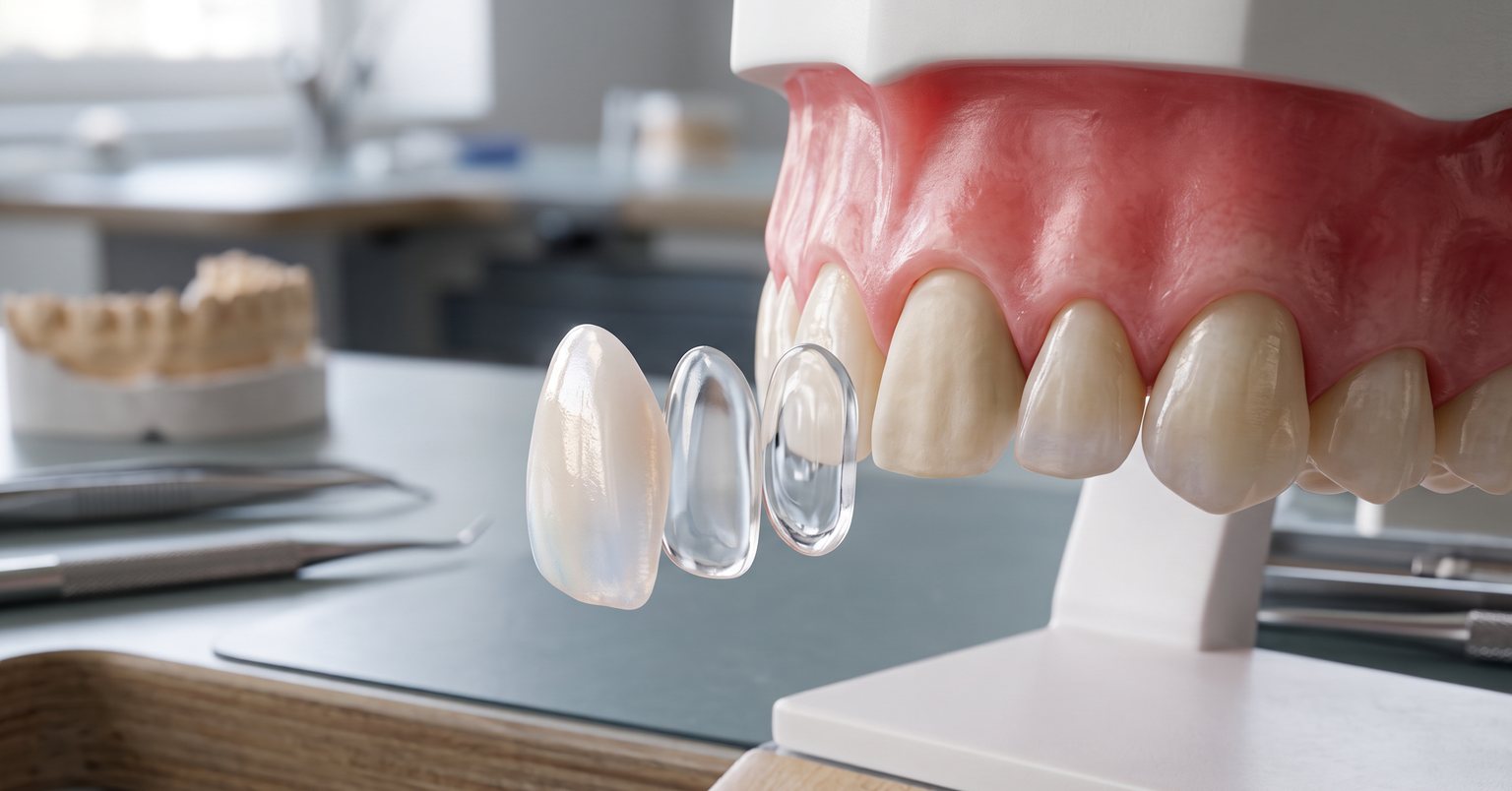
What Should You Do If an E-max Veneer Chips or Falls Off?
Stop biting on the affected tooth and arrange a dental assessment. A loose, broken or displaced veneer should be evaluated rather than ignored.
Until you are seen:
- avoid biting hard food with the affected tooth;
- keep any detached veneer or ceramic fragment if you can safely retrieve it;
- do not force a loose veneer back into position;
- keep the area clean with gentle oral hygiene;
- avoid very hot or cold foods if the exposed tooth is sensitive;
- seek prompt dental advice if pain develops.
The NHS includes a loose or broken veneer among problems that may need urgent dental advice, particularly when symptoms or trauma are involved.
More urgent assessment is appropriate if there is:
- significant or worsening pain;
- facial or gum swelling;
- ongoing bleeding;
- substantial trauma;
- difficulty breathing or swallowing;
- or another sign of serious injury.
A cosmetic chip without pain is different from a fractured tooth after facial trauma.
If there is uncertainty about whether only the veneer broke or the natural tooth also fractured, a dentist should examine the area.
Can a Chipped E-max Veneer Be Repaired?
Sometimes. The treatment depends on the size and location of the defect, the condition of the remaining ceramic, the tooth beneath it and the bite.
Possible approaches can include:
Polishing or smoothing
A very small rough edge may sometimes be polished when this does not compromise the restoration.
Composite repair
Selected ceramic chips can sometimes be repaired with resin composite after appropriate surface treatment.
This is more likely to be considered when:
- the defect is localized;
- the remaining veneer is stable;
- margins remain acceptable;
- the repair can be made aesthetically acceptable;
- and the bite does not continue to overload the area.
Rebonding
If an intact veneer has debonded, the dentist may consider rebonding it after evaluating:
- the ceramic;
- the tooth;
- residual cement;
- the bonding surfaces;
- fit;
- contamination;
- and the reason for failure.
Replacement
Replacement may be more appropriate when:
- the veneer has a major fracture;
- the restoration no longer fits;
- the margin is unacceptable;
- the tooth has changed;
- repair would be unpredictable;
- or the aesthetic defect is too extensive.
Repairability should be decided clinically rather than from a photograph alone.
Does a Broken Veneer Mean the Tooth Is Broken Too?
No. The ceramic can fracture while the underlying tooth remains intact, but the tooth can also be damaged in the same event.
This is particularly important after:
- a fall;
- sports injury;
- facial impact;
- biting an unexpectedly hard object.
A dentist may need to check for:
- enamel or dentin fracture;
- tooth mobility;
- pulpal symptoms;
- crack lines;
- bite changes;
- sensitivity;
- gum injury.
If the natural tooth is significantly damaged, treatment may involve more than simply replacing the veneer.
The restoration design may also need to change.
For example, a tooth with substantial structural loss may require a different restorative approach. See E-max Veneers vs Crowns: What Is the Difference?.
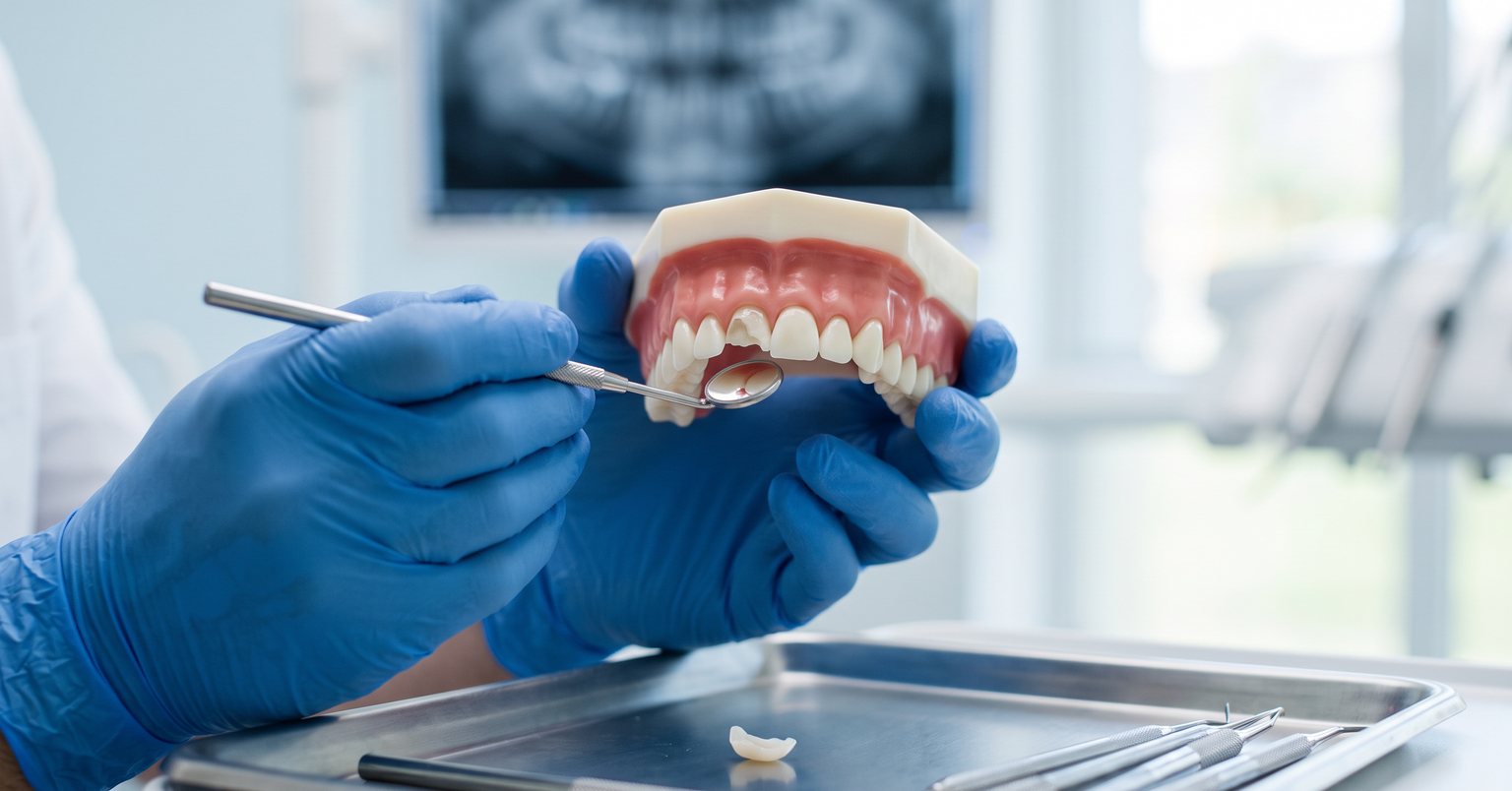
Can Veneer Breakage Be Prevented?
Not completely. Risk can be reduced, but no dentist can guarantee that a veneer will never chip, fracture or debond.
Risk-reduction strategies may include:
- treating decay and gum disease before veneers;
- preserving enamel where clinically possible;
- choosing veneers only for suitable teeth;
- creating adequate restorative space;
- controlling the bite;
- assessing bruxism;
- using appropriate adhesive protocols;
- maintaining daily oral hygiene;
- avoiding hard-object habits;
- using sports mouth protection;
- attending dental follow-up.
Patients should also report a change in bite after veneer placement.
The ADA advises patients to tell their dentist if the bite does not feel right after treatment so it can be evaluated.
Long-term maintenance matters because both the restoration and the natural mouth change over time.
For the broader evidence on lifespan and maintenance, see How Long Do Veneers Last? Lifespan, Care and Reasons They May Need Replacing.
What Should International Patients Ask About Veneer Breakage Before Treatment in Turkey?
International patients should understand the clinic’s complication and follow-up plan before treatment, because a chipped or debonded veneer can occur after the patient has returned home.
Ask:
- Which teeth are suitable for veneers?
- How much enamel is expected to remain?
- What exact ceramic material is proposed?
- How will the bite be assessed?
- Are there signs of grinding or clenching?
- What happens if a veneer chips?
- What happens if an intact veneer comes off?
- When can a veneer be repaired or rebonded?
- When would replacement be necessary?
- What follow-up is available after I return home?
- What information should I give my local dentist if a problem occurs?
- Are repair or replacement costs included in any policy, and what are the exclusions?
- What would make a veneer case unsuitable before treatment begins?
Niva Dental is located in Bakırköy, Istanbul. Ask the clinic to explain how a chipped, broken or debonded veneer would be assessed and managed.
Patients traveling for treatment can also review the Niva Dental patient journey when planning treatment and follow-up.
Ask for the current repair and replacement terms in writing before treatment begins.
Can Emax Veneers Break? The Practical Answer
For can emax veneers break, the clinically responsible answer is:
Yes—but breakage is only one type of complication.
An E-max veneer can:
- chip;
- crack;
- fracture;
- debond while remaining intact;
- loosen;
- or require replacement because the underlying tooth or margins have changed.
Current evidence supports high long-term survival for lithium-disilicate laminate veneers, but it also confirms that technical complications occur.
The best way to reduce risk is not to search for an “unbreakable” ceramic.
It is to create a favorable tooth–bond–ceramic system through:
- appropriate case selection;
- enamel preservation;
- careful preparation;
- reliable bonding;
- bite assessment;
- bruxism management where relevant;
- and long-term maintenance.
A veneer problem should be assessed according to what actually failed: the ceramic, the bond, the tooth, or the bite.
Frequently Asked Questions
Can E-max veneers break easily?
They are not expected to break easily in appropriately selected and bonded cases, but they are not unbreakable. Long-term research shows high survival for lithium-disilicate veneers while still reporting technical complications. Fracture risk depends on ceramic design, enamel and bonding, bite forces, bruxism, trauma, tooth condition and maintenance.
Can E-max veneers fall off?
Yes. A veneer can debond from the tooth without the ceramic itself breaking. If the veneer is intact, rebonding may be possible in selected cases, but the dentist should first investigate why it detached. Repeatedly rebonding without checking fit, tooth structure, bonding substrate and bite can miss an underlying problem.
What causes an E-max veneer to chip?
Chipping can be associated with excessive or concentrated force, grinding or clenching, direct trauma, hard-object habits, unsupported ceramic, unfavorable thickness or bite contacts. A chip can also occur without one obvious event. The dentist needs to evaluate the restoration and occlusion rather than assuming the material alone caused the problem.
Can a chipped E-max veneer be repaired?
Sometimes. A very small defect may be smoothed or polished, and selected chips may be repaired with composite resin. Larger fractures, poor margins, loss of fit or structural damage may require replacement. The appropriate choice depends on the size and location of the defect and the condition of the underlying tooth.
What should I do if my veneer comes off?
Avoid biting on the affected tooth, keep the detached veneer if it can be retrieved safely, and contact a dentist for assessment. Do not force a loose veneer back into place. If there is significant pain, swelling, bleeding or trauma, seek more urgent dental advice.
Does teeth grinding break veneers?
Grinding or clenching may increase mechanical risk for veneers, but the evidence cannot predict exactly what will happen to an individual restoration. The ADA identifies grinding and deep overbite as important candidacy considerations. Bite assessment and, in selected patients, a protective appliance may be recommended.
Can I eat normally with E-max veneers?
Most patients can eat a varied diet after treatment, but veneers should not be used to crack very hard objects or as tools. The ADA advises avoiding habits such as biting fingernails and chewing hard objects. Direct impact or excessive force can damage veneers and natural teeth.
Can the tooth decay under an E-max veneer?
Yes. The ceramic itself does not develop a cavity, but the natural tooth can develop decay at or around the restoration. Good brushing, interdental cleaning and dental reviews remain important. New decay can compromise the tooth and may eventually require repair or replacement of the veneer.
Does a broken veneer always need replacing?
No. Some small chips can be polished or repaired, and an intact debonded veneer may sometimes be rebonded. Replacement becomes more likely when there is a major fracture, poor fit, unacceptable margin, structural tooth damage or a defect that cannot be repaired predictably.
Is E-max stronger than natural teeth?
This is not a useful direct comparison. Lithium disilicate has high laboratory mechanical strength, but a veneer is a thin bonded restoration and functions differently from natural enamel and dentin. Clinical success depends on the combined tooth–bond–ceramic system, not a single material-strength number.
Patients concerned about E-max veneer fracture, chipping or debonding can contact Niva Dental in Bakırköy, Istanbul for an individual dental assessment. A dentist should determine whether the problem involves the ceramic, the adhesive bond, the underlying tooth or the bite before recommending polishing, repair, rebonding or replacement.
Medical References and Sources
| Source | What It Supports |
|---|---|
| Klein P, et al. — Survival and Complication Rates of Feldspathic, Leucite-Reinforced, Lithium Disilicate and Zirconia Ceramic Laminate Veneers — PMID 39523553 | 2025 systematic review/meta-analysis reporting 96.81% pooled survival for lithium-disilicate laminate veneers at approximately 10.4 years and a 6.1% technical complication rate. |
| Alenezi A, et al. — Long-Term Survival and Complication Rates of Porcelain Laminate Veneers in Clinical Studies — PMID 33807504 | Systematic review of 6,500 veneers reporting 95.5% estimated 10-year cumulative survival and identifying fracture followed by debonding as important failure mechanisms. |
| Etienne O, et al. — Survival of Ceramic Veneers: Impact of Dentin Exposure and Tooth Vitality After 1 to 15 Years of Follow-Up — PMID 40755189 | 2025 clinical evidence associating greater dentin exposure with higher failure risk and supporting enamel preservation. |
| Melo G, et al. — Association of sleep bruxism with ceramic restoration failure — PMID 28967401 | Systematic review/meta-analysis showing a risk signal for anterior ceramic veneers but very low overall evidence quality; supports cautious bruxism assessment. |
| American Dental Association / MouthHealthy — Veneers | Veneers can chip, crack, wear or loosen; grinding/deep bite are candidacy considerations; oral hygiene and hard-object avoidance are important. |
| NHS — How to find an NHS dentist in an emergency | Loose or broken veneers are listed among problems that can require urgent dental advice, especially when symptoms or trauma are present. |
| Ivoclar — IPS e.max CAD | Technical confirmation that IPS e.max CAD is lithium-disilicate glass-ceramic and can be used for veneers; manufacturer data used only for material terminology and properties. |