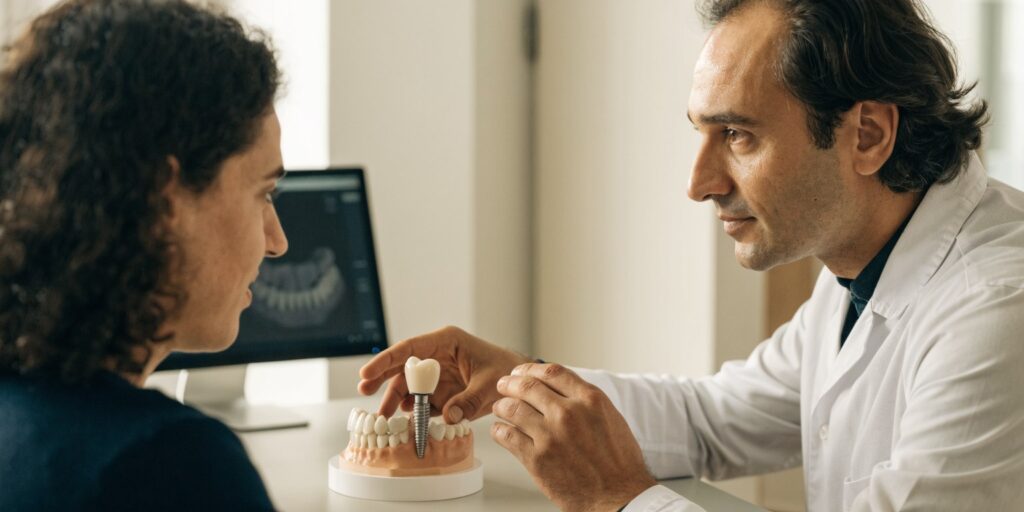



Dental implants and dentures can both replace missing teeth, but the practical choice is not simply fixed versus removable. This guide compares conventional dentures, implant-retained overdentures, and fixed implant-supported restorations by stability, cleaning, bone requirements, treatment time, maintenance, and patient priorities.

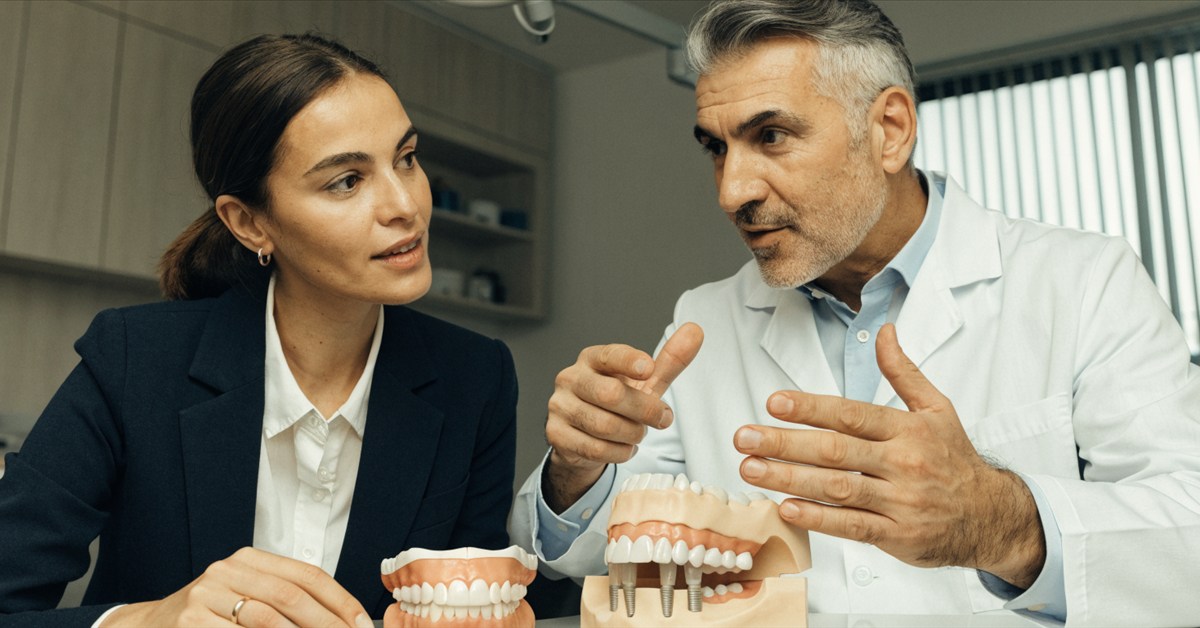
The main difference in dental implants vs dentures is how replacement teeth are supported. Conventional dentures are removable appliances that rest on the gums, while dental implants are fixtures placed in the jawbone that can support a single crown, a bridge, a removable overdenture, or a fixed full-arch restoration.
That distinction matters because the real choice is not always simply “implants or dentures.” A patient missing most or all teeth may have three broad pathways: a conventional removable denture, a removable denture retained by implants, or a fixed implant-supported bridge that the patient does not take out at home.
Each option can restore missing teeth, but stability, surgery, cleaning, bone requirements, treatment time, maintenance, and cost differ. The most appropriate choice depends on the number of missing teeth, jawbone and gum condition, medical history, dexterity for daily cleaning, expectations, and whether the patient prioritizes a fixed or removable solution.
Dental Implants vs Dentures: What Is the Main Difference?
Dental implants are anchored in the jawbone, while conventional dentures rest primarily on the gums and supporting oral tissues. The NHS describes dental implants as a fixed alternative to removable dentures and explains that implants can support a crown, bridge, or some types of dentures. NHS guidance on dental treatments also distinguishes full and partial dentures as removable tooth-replacement options.
A dental implant itself is not the visible tooth. It is the fixture placed in bone. An abutment connects the implant to the prosthetic tooth or teeth. The restoration may be a single crown, bridge, removable implant overdenture, or fixed full-arch prosthesis.
This is an important information gap in many comparisons: implants and dentures are not always mutually exclusive. Implants can retain or support a removable denture.
What Are the Three Main Full-Arch Tooth-Replacement Options?
For a person who has lost, or is expected to lose, most or all teeth in one arch, the most useful comparison is usually between three designs rather than two.
1. Conventional removable denture
A conventional complete denture replaces all teeth in an upper or lower arch. It rests on the gums and underlying ridge and is removed for cleaning. The NHS denture guidance also distinguishes complete dentures from partial dentures used when some teeth remain.
2. Implant-retained removable overdenture
An implant overdenture is still removable by the patient, but it attaches to dental implants for additional retention and stability. Depending on the design, it may connect through locator-type attachments, a bar, or another attachment system.
Cleveland Clinic’s implant-supported denture guidance describes removable implant-supported dentures as appliances that attach to implants but can be taken out for daily cleaning.
3. Fixed implant-supported full-arch restoration
A fixed full-arch restoration is attached to implants and is not removed by the patient at home. The dentist may be able to remove it when professional maintenance or repair is required.
For patients specifically exploring a fixed full-arch approach, Niva Dental also provides information about its Smile All-on-4 / All-on-6 treatment. Suitability still requires individual examination and imaging.
| Feature | Conventional denture | Implant-retained overdenture | Fixed implant-supported teeth |
|---|---|---|---|
| Support | Gums and residual ridge | Implants plus oral tissues, depending on design | Dental implants |
| Removed by patient? | Yes | Yes | No |
| Surgery required? | No implant surgery | Yes | Yes |
| Stability | Depends strongly on fit, ridge anatomy, saliva and muscle control | Usually more retentive than a conventional denture | Fixed to implants |
| Daily cleaning | Remove and clean denture and oral tissues | Remove denture and clean attachments/implants | Clean around and beneath the fixed prosthesis |
| Bone requirement | No implant bone requirement | Enough suitable bone for planned implants | Enough suitable bone for planned implant positions, or an alternative surgical plan |
| Treatment time | Generally shorter | Longer because implant healing may be required | Usually longer and more staged than conventional dentures |
| Typical maintenance | Relines, adjustments, repairs, replacement as fit/materials change | Denture maintenance plus attachment-component maintenance | Professional maintenance plus possible prosthetic component repair |
| Main appeal | Non-surgical and removable | Added retention with removable cleaning access | Fixed feel and stability |
Which Feels More Stable for Eating and Speaking?
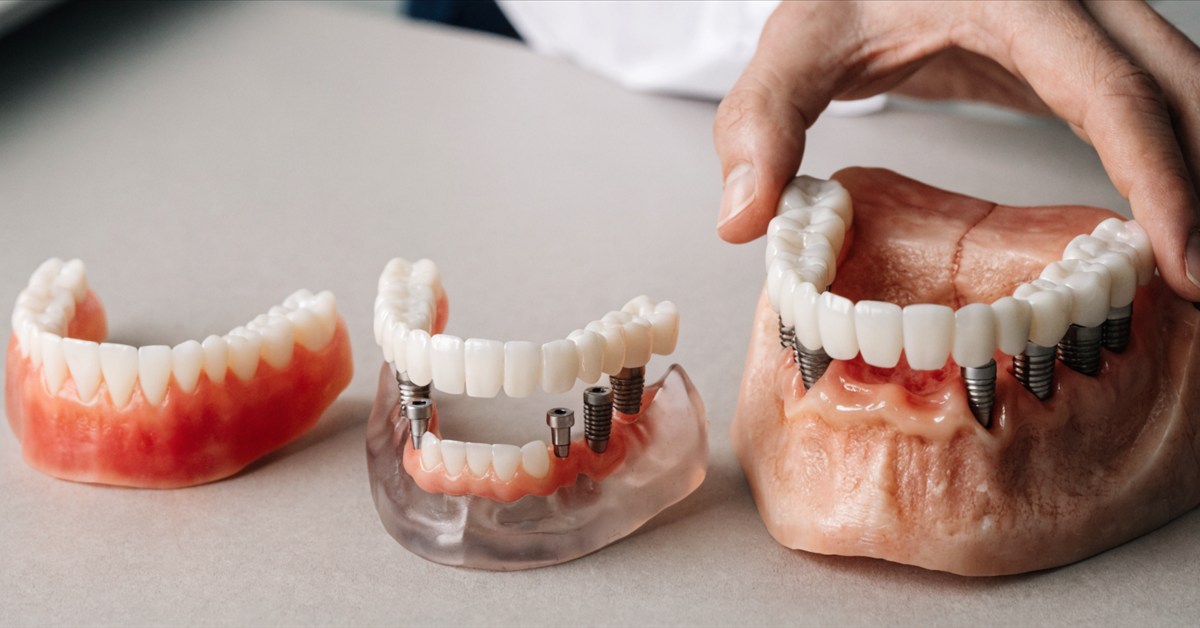
Implant-supported restorations generally provide greater retention and stability than conventional complete dentures, especially in the lower jaw, but patient experience varies. A conventional denture can work well when it fits properly and the oral anatomy is favorable, yet it is not anchored to the jawbone.
A 2026 meta-analysis of randomized studies in older adults found that implant-supported overdentures were associated with better patient-reported oral-health-related quality-of-life outcomes, particularly in oral function, although the studies were heterogeneous. PubMed: implant-supported and conventional dentures meta-analysis.
For someone struggling with a loose lower denture, an implant overdenture can offer a middle option: removable cleaning access with implant retention.
A fixed implant-supported bridge typically offers the least movement because the prosthesis is attached to implants. However, “fixed” does not mean maintenance-free, and stability alone should not decide treatment.

Are Dental Implants Better for Jawbone Than Dentures?
Dental implants interact with the jawbone differently from conventional dentures because implants are placed within bone and transmit functional forces through the implant-bone interface. Conventional dentures replace teeth above the gum but do not replace tooth roots.
After tooth loss, the residual ridge can continue to remodel, changing denture fit and sometimes creating a need for adjustment, relining, or replacement.
Implant treatment also depends on bone. Mayo Clinic explains that some patients require bone grafting when the jaw cannot adequately support the planned implant. Mayo Clinic dental implant surgery guidance.
It is therefore too simplistic to say, “implants stop bone loss and dentures cause it.” Bone changes are influenced by anatomy, tooth-loss history, implant position, loading, periodontal health, prosthetic design, age, smoking, medical factors, and maintenance.
The clinically useful question is: does the patient have sufficient bone in the right locations for the intended implant-supported restoration, or can the anatomy be managed predictably with an alternative plan?
Which Is Easier to Clean: Implants or Dentures?
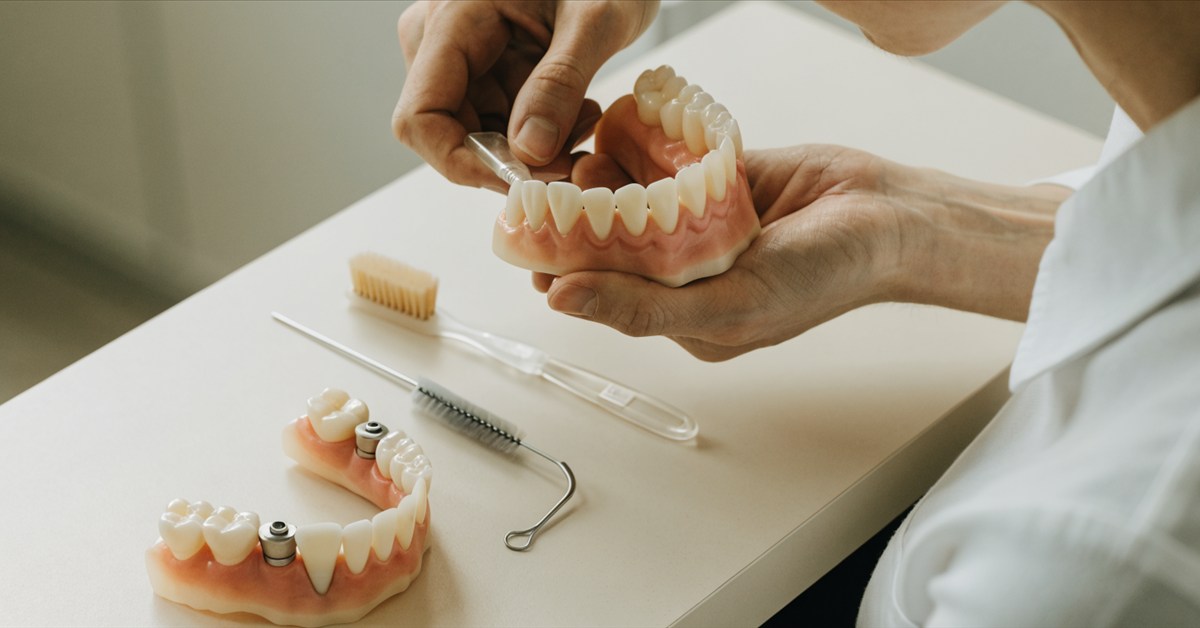
There is no universal winner. Conventional and implant-retained removable dentures are easier to take out for direct cleaning, while fixed implant restorations eliminate removal but require careful cleaning around and underneath the prosthesis.
The American Dental Association’s denture care and maintenance guidance recommends daily cleaning of removable dentures and notes that implant-supported removable dentures can be removed to access implant abutments for cleaning.
Daily care differs by design:
Conventional removable dentures
The denture is removed and cleaned separately. The gums, tongue, palate, and remaining natural teeth also need hygiene. A chronically loose or painful denture should be professionally evaluated.
Removable implant overdentures
The patient removes the prosthesis and cleans both the denture and implant attachments. Attachment components can wear and may need replacement.
Fixed implant-supported restorations
The patient brushes the prosthesis and cleans around and beneath accessible areas with tools recommended by the dental team. The prosthesis stays in the mouth, but hygiene can be more technique-sensitive.
This is why manual dexterity matters. A fixed prosthesis that a patient cannot clean effectively is not automatically a better design than a removable restoration that the patient can maintain well.
Do Implants Last Longer Than Dentures?
Implants and dentures should not be compared as though each were a single component with one expiration date.
An implant treatment includes several components—the implant fixture, abutments or attachments, screws, and the visible crown, bridge, or denture—and they do not share one maintenance timeline.
Conventional dentures may remain serviceable for years, but changes in fit, irritation, damage, or supporting tissues can require reassessment. Implant-supported prostheses also need maintenance: overdenture attachments can wear and fixed prosthetic components may require repair even when implants remain integrated.
A recent 2026 systematic review comparing fixed and removable prosthetic options for completely edentulous patients emphasized that fixed prostheses may offer strong function and stability but can involve more complex hygiene and technical complications, while removable overdentures provide easier cleaning access but have their own maintenance needs. PubMed systematic review of fixed and removable modalities.
The more accurate question is therefore not “Which lasts forever?” but “What maintenance is likely for the implant fixtures, attachments, and prosthetic teeth over time?”
Which Treatment Takes Longer?
Conventional dentures usually have a shorter treatment pathway because they do not require implant surgery or osseointegration. Implant treatment generally takes longer because the implants must be planned, surgically placed, and allowed to heal before or during the restorative stages.
Osseointegration is the biological process in which bone forms a close connection with the implant surface. Mayo Clinic notes that this bone-healing phase can take months and that the complete implant process may involve several stages.
Some patients may receive temporary teeth during the healing phase, and selected full-arch protocols may permit a fixed temporary restoration soon after implant placement when clinical conditions allow. That should not be confused with completion of healing or placement of the final restoration.
For international patients, this distinction is especially important. “Teeth in one day” can refer to the timing of a temporary prosthesis rather than the entire implant treatment being biologically complete in one day.
Niva Dental’s patient journey includes an initial consultation and treatment-planning stage. Remote review can help organize a likely pathway, but final implant suitability and treatment sequencing require appropriate clinical assessment.

Which Costs More: Dental Implants or Dentures?
Dental implants usually involve a higher initial treatment cost than conventional removable dentures because implant treatment includes surgery, implant components, imaging, restorative components, and additional clinical stages. However, comparing only the first invoice can be misleading.
A fair comparison should ask exactly what is included:
- implant fixture only or completed restoration;
- temporary and final prostheses;
- extractions;
- bone grafting or sinus augmentation;
- removable versus fixed design;
- final prosthetic material;
- expected maintenance, relines, attachment changes, repairs, or replacement.
Conventional dentures typically have a lower entry cost and avoid implant surgery. Implant overdentures sit between conventional dentures and fixed full-arch treatment in many treatment plans, but actual pricing depends on implant number, attachments, prosthetic design, laboratory work, and local fees.
This article does not provide Niva-specific prices because current case-specific pricing should be verified directly rather than inferred. For the factors that shape implant pricing, see our guide to dental implant cost in Turkey.
Who May Prefer Dentures, Implant Overdentures, or Fixed Implants?
The best option depends on anatomy, health, function, hygiene ability, treatment goals, and personal priorities.
Conventional dentures may be considered when:
- the patient wants a non-surgical option;
- implant surgery is not desired or is not currently appropriate;
- budget makes implant treatment unrealistic;
- a removable solution is acceptable;
- anatomy allows a clinically acceptable denture fit.
Implant-retained overdentures may be considered when:
- a conventional denture lacks enough retention or stability;
- the patient wants more security but still prefers a removable appliance;
- easier direct cleaning access is important;
- sufficient bone and health conditions permit implant placement.
Fixed implant-supported teeth may be considered when:
- the patient strongly prefers teeth that are not removed at home;
- bone and anatomy support the planned implant positions or can be managed appropriately;
- the patient can perform the more specialized daily hygiene required;
- medical and periodontal conditions are suitable for implant treatment;
- the patient accepts surgery, healing time, cost, and future professional maintenance.
Age alone does not determine the answer. Oral health, bone, healing risk, hygiene, and medical history matter more than a simple age cutoff.
What Should You Compare Before Choosing?
A useful dental implants vs dentures decision should compare the final everyday experience, not only the procedure.
| Decision question | Why it matters |
|---|---|
| Do I want a fixed or removable restoration? | This affects feel, cleaning, maintenance, and treatment design. |
| How many teeth are missing? | A single missing tooth, several missing teeth, and a fully edentulous arch require different prosthetic strategies. |
| Is there enough healthy bone? | Implant positions depend on available bone and nearby anatomy. |
| How healthy are the gums and remaining teeth? | Active disease may need treatment before definitive restoration. |
| How important is maximum stability? | Implant support can reduce movement compared with conventional dentures. |
| Can I clean under a fixed bridge every day? | Hygiene access is central to long-term implant health. |
| Do I want to avoid surgery? | Conventional dentures do not require implant surgery. |
| How quickly do I need a usable prosthesis? | Denture and implant timelines differ, and temporary teeth are not the same as final treatment. |
| What maintenance am I comfortable with? | Dentures, attachments, and fixed implant prostheses all have different maintenance needs. |
| What is included in the quoted cost? | Comparing incomplete quotes can make one option appear artificially cheaper. |
For patients leaning toward implants, Niva Dental’s main guide to dental implant treatment in Istanbul explains the broader implant pathway. A clinical examination and appropriate imaging are still required to determine which fixed or removable design is suitable.
Frequently Asked Questions
Are dental implants better than dentures?
Not for every patient. Dental implants generally provide greater retention and can support fixed teeth or removable overdentures, but they require surgery, suitable anatomy, healing time, hygiene, and a higher initial investment. Conventional dentures avoid implant surgery and remain a valid option for many patients. The better choice is the one that fits the patient’s health, anatomy, function, maintenance ability, and priorities.
Can dentures be attached to dental implants?
Yes. An implant-retained overdenture uses dental implants to improve the retention of a removable denture. The patient can still remove the denture for cleaning. This differs from a fixed full-arch implant bridge, which the patient does not remove at home.
Do implant-supported dentures come out at night?
Removable implant overdentures can be taken out by the patient and their wearing schedule should follow the treating dentist’s instructions. A fixed implant-supported full-arch restoration is different: it remains attached and is not removed by the patient at night.
Can you switch from dentures to dental implants later?
Sometimes. Existing denture wearers may later be evaluated for implants, but candidacy depends on current bone volume, gum health, medical factors, anatomy, and the planned restoration. Long-term tooth loss can be associated with ridge changes, so imaging may be needed to determine whether grafting or another implant design should be considered.
Which is easier to eat with: implants or dentures?
Implant-supported restorations generally offer greater stability than conventional complete dentures, which can improve confidence during chewing for many patients. However, chewing ability also depends on bite design, muscle function, adaptation, prosthesis quality, and whether the restoration is fixed or removable. Individual results vary.
Are fixed implant teeth maintenance-free?
No. Fixed implant-supported teeth still require daily cleaning around the prosthesis and implant sites, regular professional review, and maintenance of prosthetic components when needed. The fact that the patient cannot remove the bridge does not make it maintenance-free.
What is the difference between All-on-4 and dentures?
All-on-4 is a full-arch implant treatment concept in which a fixed prosthesis is supported by implants. A conventional complete denture is removable and rests on the gums rather than being fixed to implants. An implant overdenture is a third option: it attaches to implants for retention but remains removable by the patient. Learn more about All-on-4 and All-on-6 at Niva Dental.
Should I choose implants just because I am younger?
No. Age alone does not determine implant candidacy. Bone condition, gum health, smoking, medical history, healing capacity, oral hygiene, number of missing teeth, and treatment goals all matter. A younger patient can still be a poor candidate until active disease or other risk factors are addressed.
Fixed or Removable: The Better Choice Depends on the Patient
The most useful way to compare dental implants vs dentures is to separate three options: a conventional removable denture, an implant-retained removable overdenture, and a fixed implant-supported restoration.
Conventional dentures avoid surgery and generally have a shorter, lower-cost initial pathway. Implant overdentures add retention while preserving removable cleaning access. Fixed implant-supported teeth provide the most fixed experience but require surgery, suitable anatomy, careful hygiene, and ongoing professional maintenance.
For international patients considering treatment in Istanbul, the first step should be a clinical and restorative assessment rather than choosing from a price list. An initial records review can help organize options, but final eligibility and design require appropriate examination and imaging.
Medical References
- NHS. Dental treatments — Dental implants and dentures. https://www.nhs.uk/live-well/healthy-teeth-and-gums/dental-treatments/
- NHS. Dentures (false teeth). https://www.nhs.uk/tests-and-treatments/dentures/
- Mayo Clinic. Dental implant surgery. https://www.mayoclinic.org/tests-procedures/dental-implant-surgery/about/pac-20384622
- American Dental Association. Denture Care and Maintenance. https://www.ada.org/resources/ada-library/oral-health-topics/dentures
- Cleveland Clinic. Implant-Supported Dentures: Process, Benefits & Care. https://my.clevelandclinic.org/health/treatments/24303-implant-supported-dentures
- Heboyan A, et al. Implant-Supported and Conventional Dentures: A Meta-Analysis in Older Adults. International Dental Journal. 2026. https://pubmed.ncbi.nlm.nih.gov/42567046/
- Hassan MAA, et al. Choosing Between Fixed and Removable Prosthetic Modalities for Completely Edentulous Patients: A Systematic Review of Evidence-Based Outcomes. 2026. https://pubmed.ncbi.nlm.nih.gov/41669595/
- Sivaramakrishnan G, Sridharan K. Comparison of implant supported mandibular overdentures and conventional dentures on quality of life: a systematic review and meta-analysis of randomized controlled studies. Australian Dental Journal. 2016. https://pubmed.ncbi.nlm.nih.gov/26836981/